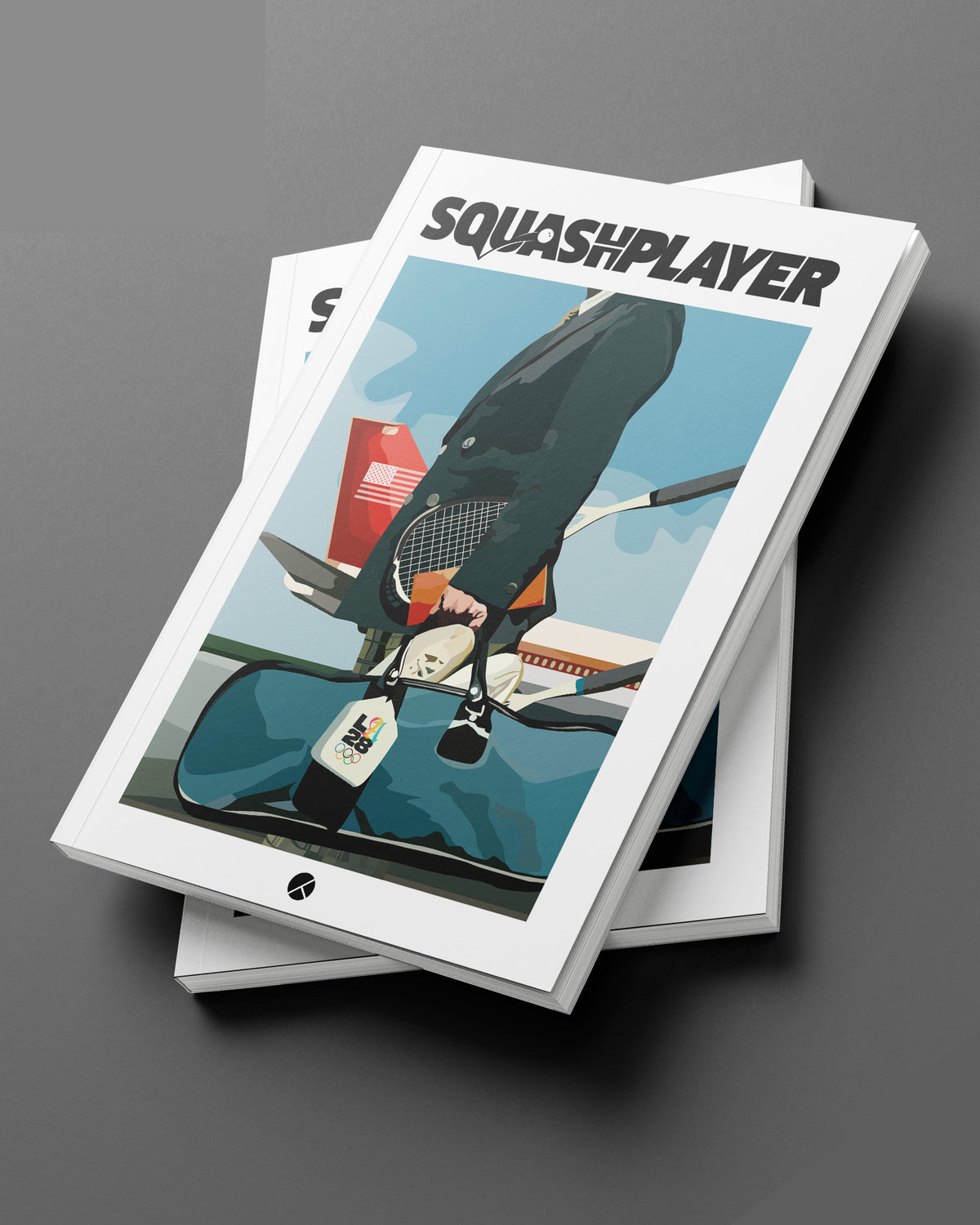



(Extract from Squash Player Magazine 1996)
Martin Bronstein Travels To The Pyramids To Watch The Egyptians Stage A Squash Spectacular In The Desert.
I saw my first professional squash match at the Toronto Squash and Badminton club in 1979.
It was the hardball game on a narrow court with just a balcony for the 25 or so spectators. As I was in the third row I could see only the front half of the court and consequently spent most of the time watching the ball fired down the walls by players who were only occasionally seen going after an adventurous drop shot or three-wall nick.
Now, 17 years later, I sat in a padded arm-chair, cooled by the wind of the Sahara desert, watching far more accomplished players perform in the open air in a transparent Perspex court, surrounded by thousands of other spectators with the three flood-lit Pyramids as a back drop.
Squash, you've come a long way, baby.

What other sport can claim such enormous change and advances in presentation?
Before we get to the tournament report, it would be highly remiss of me not to express my admiration at the Egyptians for their courage and imagination in the staging of the Al Ahram tournament. To stage a squash tournament in the open air takes optimism to start with, but to place it in the desert, beside the Pyramids with all the obvious (and some not so obvious) problems takes courage.
The first round at the Cairo Stadium courts produced a couple of notable events. First was the return of Simon Parke after his bout with chemo-therapy. To say that everybody was delighted and moved by his appearance is to understate the case. True he looks better with hair, but that didn't seem to affect his first round match against Karim El Mistikawa, whom he beat comfortably in three.
Second was Danny Meddings' defeat of shooting star Mark Chaloner. Meddings has had a mixed year, and his ranking dropped to 20 from a high of 13. It was a long battle with Meddings getting easily his best result of the year, winning 15-13 in the fifth. Chaloner was bitterly disappointed that he would not make an appearance in front of the Pyramids. Five Egyptians were in the first round and only one made it through to the second: Ahmed Barada, the world junior champion. His performances in succeeding rounds were to light up the desert.
The players, referees and journalists moved from downtown Cairo to the Mena House Oberoi Hotel in Giza with a police escort to speed them through the heart stopping, kamakazi, suicidal experience that is Cairo traffic. I survived - so did the knots in my stomach.
Play started after the sun had set and Simon Parke and Derek Ryan had the privilege of playing first in this historic environment. Parke survived a first game battle to win 17-15 and then took the next two 15-11, 15-7. Craig Rowland made Jansher Khan work hard for his 3-1 victory and Martin Heath made Mark Cairns, now ranked 13th, work even harder before the Englishman emerged a 3-2 winner. Heath, ranked 32, can be more than pleased with his day's work and will almost certainly be in the top 16 before the end of next season. Peter Nicol, still hanging onto his 4th spot on the PSA ranking list, despite some bad results, continued his run of 3-0 victories, beating Jason Nicolle in the second round as he had Tim Garner in the first.
Jonathan Power, the emerging Canadian, now up to 19 in the rankings, had a long grim battle with Chris Walker over 85 minutes. The scoreline: 13-15, 13-15, 15-11, 15-13, 15-12, shows just how close the two are despite the 12 places that separate them in the rankings.
Danny Meddings came up against the home town boy, Barada, and lost in three, which ensured increased TV coverage and sell-outs for the next two nights.
The highlight of the second round was the marvellous battle between Rodney Eyles and Zarak Jahan Khan. Eyles on form is a delight to watch, a truly inventive and clever tactician with a range of magical shots. Zarak, once noted merely for his athleticism and his ability to return, has matured into a player with a determined attack. The entire court was used, front, back, sides, and height, with Eyles constantly, cruelly testing his opponent with that delicate chopped backhand drop. At 11-11 in the first, Zarak had forced Rodney to boast from the back right corner and naturally played a drop shot. Eyles came tearing along the diagonal at 60 mph and played a delicate backhand drop that left Zarak rooted in disbelief. Eyles won 15-13, 10-15, 15-13, 15-11 but Zarak went off to hearty applause - not quite as hearty as that for Barada, but what can you expect?

THE QUARTERS
Peter Nicol lost his first game against Mark Cairns 9-15, but took the next three 15-11, 15-7, 15-6 to earn a semi-final place against Jansher Khan, who had little trouble disposing of Simon Parke in three; towards the end of the match it was evident that Parke was not yet match fit.
Chris Walker showed total concentration in beating Brett Martin in three straight, a result he hasn't accomplished since 1994 in Qatar. This was a new Walker, no chat, no whining, just getting on with it in his all-court style. He admits that since getting rid of his PSA responsibilities and other admin jobs and letting Neil Harvey take over his management he has been able to concentrate purely on his squash, and it clearly shows.
The event of the night was the exploits of Barada, the boy King who will surely have his own pyramid built in commemoration. Barada, number 29 in the world, beat Eyles, number two. You can't be serious? That's exactly what happened.
This wasn't a squash match or even football chanting - this was mega pop star hysteria. The spectators comprised a proper sociological mix of children, adults, men, women, government mandarins, grannies in traditional dress, pregnant women and gorgeous women. They had come to see Egypt's (junior) world champion, a man who's name breaks down handily into a chanting triplet BA-RA-DA, BA-RA-DA, BA-RA-DA, BA-RA-DA.
Each winning shot was followed by an explosion of joy, each losing point, heart-wrenching groans. Poor Rodney Eyles, he trailed all the way through the first game. He got his fourth point on a stroke to trail 4-10; then an Eyles error, followed by a Barada drop, another Eyles error, a Barada winner and finally another error from Eyles gave Barada the first game 15-5. Extreme pandemonium barely describes Barada's triumphant exit from the court for the break
This was not the Eyles that had beaten Zarak. Throughout the first game and the second there had been constant chat, firstly Barada had Eyles cautioned by the appeals eferee and then Eyles had demanded a similar warning for Barada. I sat next to the great Karim throughout this match and he was very displeased at the conduct of both players.
"Play the ball, get, on with the game," he chastised.
Barada won the final point of the second game on a stroke and match point on an Eyles error. Sixty minutes of disputatious squash, wonderful drop shots and extreme crowd participation now turned into 20 minutes of delirious celebration. It was well past midnight, the wind off the desert was chilly and it was time for bed.

Ahmed Barada
THE SEMI-FINALS
Jansher Khan now walks the court imperiously, his squash a demonstration of relentless perfection. His shot selection is faultless and the execution exquisite, producing the utmost discomfort for his opponent. Peter Nicol could handle six, seven or eight shots and produce a challenging reply, but the ninth shot would find him just a foot off, and the weak reply would be dealt with pitilessly.
"He expects to win,' Nicol told me over a very late dinner that evening after his 15-11, 15-9, 15-7. He also realised that he had made the mistake of playing too much over the last two years, arriving at the British Open exhausted, which accounted for his lamentable record at that august event. Now he and Neil Harvey will pick his activities very carefully and allow his body to recover fully from illness.
I would have happily put money on Walker to beat Barada; fortunately there were no takers. This was the match where the new 2-man officiating system failed because of the inexperience of the referee. It has to be said that Barada appeals almost every losing situation; his appeals are as automatic as the hooting of the horns of Cairo drivers and just as vexing. The inexperienced local referee made a host of wrong decisions, which would then be immediately appealed by the 'wronged' player.
The appeals referee, Graham Horrex, was obliged to overturn in the region of 35 decisions. It doesn't have to be spelt out what happened to the spectators when the overturn went against Barada. Horrex kept his cool till the last; I don't know how the local referee felt, but he certainly needs another 200 matches under his belt before officiating at this level again.
The first 24 minute game was nip and tuck all the way with never more than two points separating the players. They were level at 11, 12, and 13 and Barada's shots were exquisite when working and painful when down. He levelled at 13 by slamming Walker's serve into the nick. An unforced error gave Walker game ball and when Barada waved his racket looking for a stroke, the ball sailed by and nicked on the back wall. He screamed for a let. He was refused and the crowd went slightly dangerous.
In the second game Walker hit a fine drop to trail 6-10. Barada wanted a let, it was refused, he argued and was finally given a code of conduct warning. Had it been given at the beginning of the first, a lot of time could have been saved. Barada won the game to make it 1-1 and then another nail biter in the third, trading shot for shot, point for point until 14-all when Walker elected to go for three and, playing too loosely, lost all three points. Barada lead 2-1.
Barada's error rate increased in the fourth and at the half-way point Walker moved into his Dangerman persona playing winners with ease to take the game 15-9 in 11 minutes. It looked exactly like the right tactic but he could not recover that form in the fifth as once more they were locked in a point for point battle; from 6-all it was alternate points played in an atmosphere of almost unbearable tenseness. At each winning point, Barada fans jumped out of their seats and rushed towards the court walls waving and jumping.
I have to admit such was the emotion around me, I can't remember the last two points. I know Barada won them, to throw himself prostrate with joy on the court floor as a huge surge of spectators flooded towards the court.
The undreamed of had happened - Barada would play Jansher in the final.
It was a tremendous victory played to a crowd whose emotion I never thought I would see in a squash tournament.

THE FINAL
Needless to say, the final was an anticlimax; only the world junior champion beating the world champion could have topped the semi-final and there was never a chance of that happening.
Mr. Relentless Perfection did what he always does; teaches his opponents how far they have to go before they can even dream of beating him. It was all over 15-4, 15-11, 15-8 in 42 minutes and Jansher had another trophy for his vault.
All I can say is, what a tournament! What a venue! What a huge boost for the game of squash!
You can watch the highlights of the event below