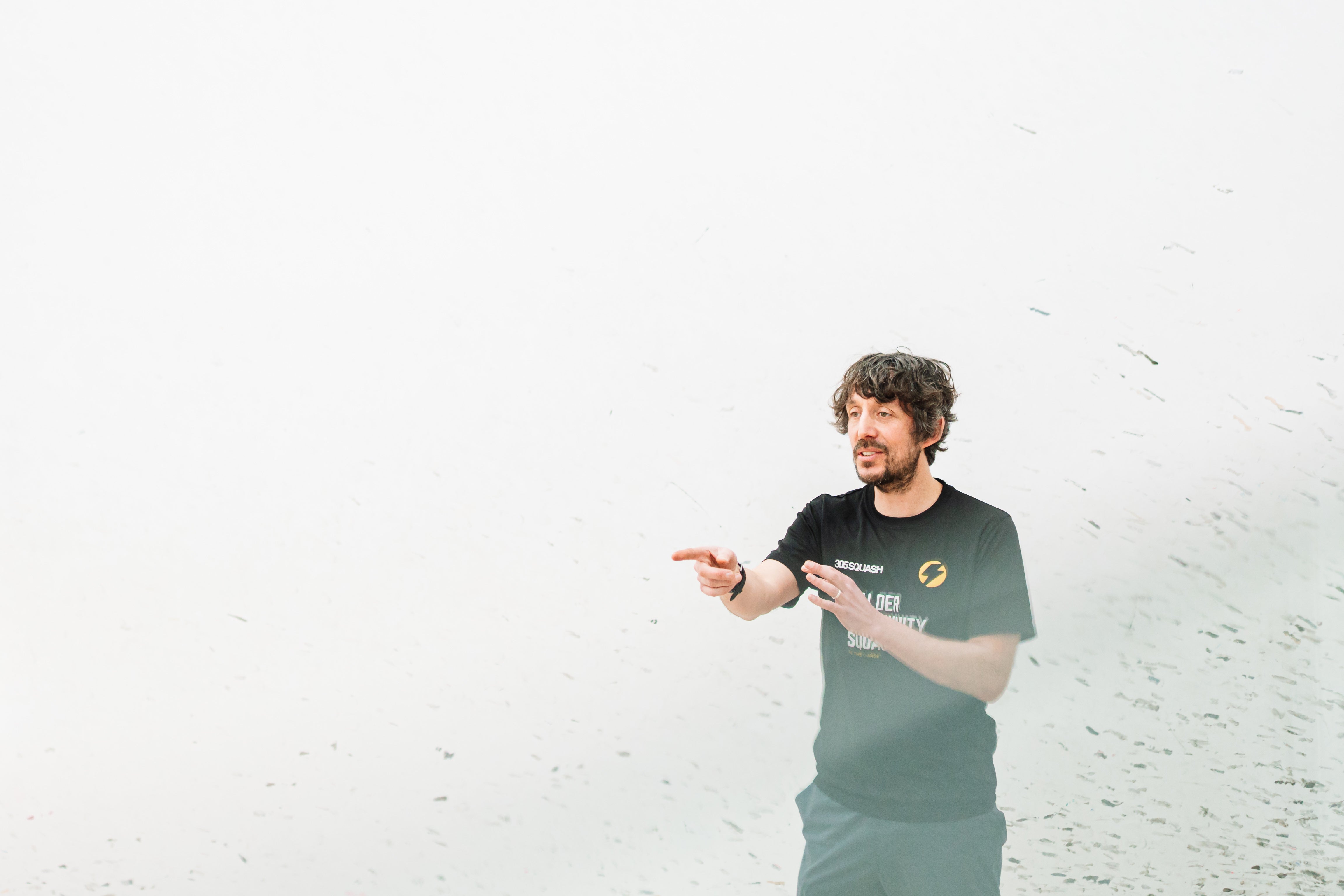




When Nick Taylor was appointed as Head Coach of US Squash last month it was the culmination of a journey that is seldom seen in sports.
For Coach Taylor’s narrative starts not in the halls of some major US sporting institution, but on a small, largely unknown island – Jersey – where squash was a niche activity struggling to find its place.
But after years of grassroots work on the tiny Channel Island, followed by a successful transition to creating his first Academy in the US, Taylor has taken on his biggest challenge yet: leading the US national squash team, arguably the most ambitious squash program in the world, as it gears up for the sport’s Olympic debut at the Los Angeles 2028 Games.
The leap from running a local squash program on a small island to overseeing the future of squash in a country as vast as the United States is no small feat. The US squash program is a vast operation, unlike anything Taylor has tackled before, brimming with unmatched resources, premier facilities, and a deep roster of talented players.


Yet, having cut his teeth as an assistant coach to icons David Pearson and Paul Carter within England’s high-performance setup from 2004 to 2008 – a transformative period that produced England’s “golden generation” with stars like Nick Matthew, James Willstrop, and Laura Massaro – Taylor feels primed to renew his ties to the elite level.
This, he believes, is the perfect arena to bring his grassroots-honed expertise to the world stage.
“I have the experience of working within a great set-up in England and working closely with elite players – which extended beyond the English team to the likes of Anthony Ricketts and Stephen Coppinger – but I’m not coming into this role with US Squash just for high-performance coaching,” he asserts.
“I’m coming in to bridge the gap between grassroots development and elite competition, to utilise my experience across all levels of the game and build something truly world-class from both a coaching and performance perspective.
“I’ve got a lot of work ahead of me but it’s exactly the kind of challenge that excites me.”
His confidence is born not from a background steeped in elite sports performance, but from a career defined by defying expectations and transforming squash cultures from the ground up.
Taylor’s squash journey began in Manchester, England, where he emerged as a competitive squash player on the PSA World Tour, peaking at No. 14 in the world. Despite his playing credentials, when he arrived in Jersey in 2008 – after four years coaching in his hometown – to take over as the director of squash at the Jersey Squash and Racketball Club, he wasn’t stepping into an elite role.
Instead, he was walking into a neglected club with less than 100 members that barely registered on the island’s radar.
Rather than be deterred by the daunting task of popularising squash on such a small scale, Taylor seized the opportunity to make his mark.
He made grassroots outreach his priority, launching school programs that introduced the sport to over 8,000 children within a year.
“I was told it was impossible, that I’d never get into more than eight schools,” Taylor recalls. “But I just thought, ‘watch me.’”
By the time he left Jersey in 2017, he had built a thriving squash culture on the island, tripled club membership, and earned the island recognition by the European Squash Federation. Jersey even took home two bronze medals at the European Team Championships, stunning more established nations and cementing Taylor’s legacy as a transformative figure in the sport.


2017 marked the beginning of a significant new chapter as Taylor, and his family, moved across the pond. He first took on roles at local squash clubs, including Cross Courts in Massachusetts, gradually integrating into the American squash scene, where he gained a reputation for revitalising programs and developing young talent – none more so than through his Nick Taylor Academy set up in Boston.
He was then able to prove himself on the US national stage as he was a part of Team USA’s coaching staff during their record-setting 2023 and 2024 British Junior Opens.
However, there is a stark difference between his past roles and the demands he now faces as the head national coach for US Squash – where success is measured in world rankings and Olympic preparation.
The step up in expectations and responsibilities could be seen as a gamble, with skeptics questioning whether Taylor’s lack of experience at the highest levels of performance coaching could hinder his success. But Taylor is not fazed by the challenge.
“I know I’m coming from a different background than most national coaches,” he acknowledges. “But I’ve built programs from nothing before. I’ve seen what works at the grassroots level and how to scale that up.
“The task here is bigger, no doubt, but I believe in a holistic approach to building players – from the local courts all the way to the Olympic stage. That’s the journey I’m excited about.”
With Taylor at the helm, US Squash is not merely looking to compete but to redefine its ambitions as the sport heads toward LA28. The Specter Center, an 18-court facility in Philadelphia, serves as a critical piece of Taylor’s plan, acting as the nerve centre for the national team’s training and development.
Yet the goal is not simply to prepare elite athletes; it’s about cultivating a culture that can sustain long-term success.
“The US is a unique beast,” Taylor explains. “US Squash is one of the only governing bodies in the world who has their own facility – most other federations lease, or hire, their central facility.
“I’ve played at the top level, I’ve worked with professional players and I’ve built programs and I’ve produced junior players. So I feel there’s a lot of connection there and that’s very important to me.
“The challenge is to connect the governing body and the programs around the country and to try and strengthen that, but at the same time build a world class programme at the Spencer Center itself, from grassroots to greatness, so that it becomes a true hub in this country.
“Whether they’re juniors, college athletes, or pros, I want the centre to feel like it’s their home base.”
Taylor recognises that much of the US squash scene has historically revolved around the college pathway, where many young players see college squash as the end goal. To shift this mindset, he aims to strengthen the transition from college to professional play, ensuring the US has a steady pipeline of talent moving into the top tiers of world squash.
Taylor’s approach to bridging grassroots efforts with elite performance is central to his vision for US Squash. He intends to build on the momentum created by US players like Amanda Sobhy and Olivia Weaver, who have already established themselves among the world’s best.


For Taylor, these players are not just assets but role models who can inspire the next generation of American squash talent.
“There is a great generation of talent already playing here and that is something to nurture – and if we can convert more of the College talent onto the professional circuit, that will only be beneficial for US Squash in the long run,” he says.
“But my role is to come in and compliment the systems that are already in place. There are great coaches that are currently working with our top players and I’m not replacing them, it’s about supporting them as much as the players themselves and trying to foster an environment that encourages and develops success at all levels.”
While the elite game will demand much of Taylor’s attention, he is also keen on promoting Squash57, an offshoot of squash that Taylor had successfully championed in Jersey. At the Specter Center, he envisions Squash57 as a tool for engaging new players, especially those unfamiliar with the sport.
“In Jersey, Squash57 turned things around for us,” Taylor says. “We need to make the sport accessible and appealing to everyone, from players returning to the sport through to introducing people with no racket/ball experience and to retirees.
“It’s about creating an environment where the love for squash can grow at every level. I know Squash57’s value. I know what it does. It retains, it brings people back. Squash is very, very challenging, especially for beginners – Squash57 can act as a great bridge and bring people in, who may then progress into adult squash.”
As US Squash prepares for the biggest stage it has ever seen, Taylor is aware that the spotlight of the LA 2028 Olympics presents both a massive opportunity and a daunting challenge.
Squash will finally be showcased to a global audience, and for Taylor, the stakes could not be higher.
“The Olympics are a dream come true for our sport. It’s a chance to show the world what squash is all about,” he says. “But we need to do more than just show up.
“We need to make sure we’re competing for medals and proving that squash belongs in the Olympics for years to come.
“This is about building a legacy,” Taylor emphasises. “It’s not just about the 2028 team. It’s about setting up a system that continues to produce world-class players long after I’m gone.
“The US has the resources, the coaches, the facilities, and the talent pool. We just need to put it all together, and that’s what I’m here to do.”
For Nick Taylor, the leap from local hero to national head coach is more than just a career transition; it’s a testament to the power of grassroots development and the belief that anything is possible with enough vision and hard work.
The challenge is monumental, the expectations high, and the stakes higher still, but Taylor thrives on defying the odds.
“This is exactly where I want to be,” Taylor declares.