





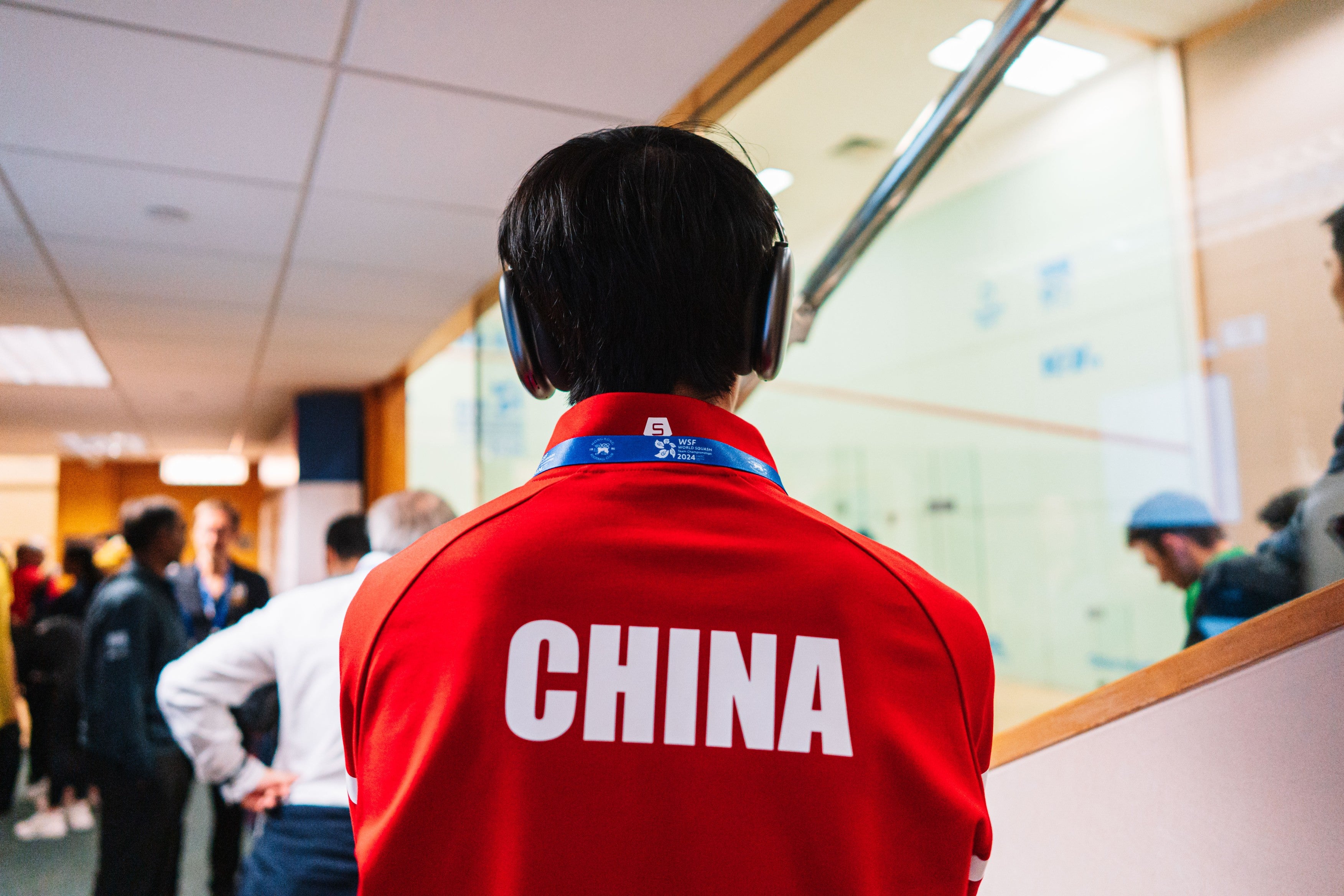
In a nation that thrives on the roar of the crowd and the spectacle of victory, the rise of squash has been a whisper.
By Nathan Clarke
For years, squash enthusiasts had hoped and dreamed, their voices rising in unison, calling for the sport’s inclusion in the Olympic Games. They saw it as the silver bullet, the solution to all their challenges and frustrations.
So when the news broke last year that squash had finally, after three long decades, secured a coveted spot on the Olympic roster, it felt like a collective sigh of relief across the global squash community.
They expected an immediate transformation, a magical turning point. Yet, transformation rarely happens overnight.
In the months that followed, it became clear that change would come, but in quieter, more subtle ways. A year after that landmark decision, the seeds of change are taking root, particularly in the world’s biggest sporting superpower: China.
In a nation that thrives on the roar of the crowd and the spectacle of victory, the rise of squash has been a whisper. It has moved stealthily, like a secret waiting to be discovered. Traditionally, squash was a pastime of expatriates, a leisure activity that helped burnish the credentials of those aspiring for Ivy League admissions. But something has been stirring in the vast, teeming cities of Shanghai and Beijing, where the hum of construction competes with the rhythm of daily life. Here, beneath the surface, a quiet revolution is brewing.
Substance was added when, in the midst of last summer, it was announced that Ong Beng Hee, a former World No. 7 and a respected figure in the squash world, would be relocating to Beijing to take the helm at the newly established Dream Squash Academy after spending three successful years as the head coach of the United States national team.


For many, this move might have seemed like just another high-profile transfer, akin to the big-name footballers chasing fortunes in the Saudi Pro League. But Beng Hee’s motivations are different. His gaze is set on something more profound than a quick payday.
“Since squash was confirmed as an Olympic sport last year, it has gained increasing recognition in China, with a growing demand and rapid rise in young players,” Beng Hee, a Malaysian with deep roots in the sport, said. As a player, he had twice claimed gold at the Asian Games, and as a coach, he had guided the US Women’s Team to their first-ever WSF World Team Championship final.
Now, his mission is clear: to cultivate the next generation of Chinese squash players.
“The resources and potential there are enormous,” he continued. “Dream Squash is confident in its ability to impact the development of squash in China, ultimately benefiting the sport on an international scale. The focus is to provide the young players with a structured training programme – a platform to support this game from grassroots to elite. Together with dedicated parents, we have founded this academy, with Beijing as our first centre and long-term plans to expand to other regions in China.”
Beng Hee’s background is as diverse as his ambitions. Before making his mark in the US, he had honed his skills and strategies in Malaysia and Qatar. His journey across these varied landscapes has given him a unique perspective and the kind of experience that could ignite the Chinese squash scene.
With his family lineage connecting him to China, he feels a personal calling to be part of this transformation.
For years, squash in China was seen as the sport of a select few—the children of the elite who harboured dreams of Harvard, Yale, and Princeton. It was a sophisticated choice, a sport that spoke of discipline and distinction.
As Lim Chee Ming, a seasoned coach who has been a quiet witness to this evolution, explained: “Squash in China used to be popular mainly among those who wanted to get into U.S. Ivy League schools. That’s still a major driving force, with many parents pushing their children to excel in squash as part of their education and college application strategy.”


In a society where education is a currency more valuable than gold, squash carved out a niche. It was a sport that demanded more than just physical prowess; it called for strategic thinking, mental fortitude, and an air of exclusivity.
In the sleek, glass-walled courts of Shanghai’s high-rise clubs, young players swung their rackets with the precision of those who knew that every rally could bring them closer to a future filled with promise.
Now, with squash’s inclusion in the 2028 Los Angeles Olympics, this quiet passion could be on the verge of a public explosion. China’s approach to sports is pragmatic, almost mathematical: if it’s in the Olympics, then it’s worth the investment.
This philosophy, which has turned the nation into a powerhouse in sports like diving and table tennis, is now being applied to squash.
“The inclusion of squash in the LA28 Olympics is going to boost the sport even more in China,” Lim said. “The government is already getting more involved, and this Olympic push will accelerate the growth, much like what happened with tennis in China over the past 15 years.”
The rise of high-end squash clubs and the introduction of cutting-edge, four-sided glass courts have already begun to attract a new wave of players – both serious competitors and social enthusiasts. Over fifty clubs exist across major urban centres, each one a testament to the sport’s burgeoning appeal.
China’s sporting machinery is efficient and relentless. Where there is potential for a medal, there will be investment, recruitment, and training. The government has begun scouting for talent, drawing promising athletes from other disciplines, like badminton, and channeling their skills into squash. This strategy of cross-pollination is not new; it echoes China’s rise in tennis, a sport that, just over a decade ago, was barely on the radar. Today, Chinese players are winning gold on the world stage.
“Historically, China has shown a remarkable ability to quickly develop world-class athletes once a sport gains Olympic status,” Lim pointed out. “This strategy, combined with the Olympic spotlight, could significantly elevate China’s presence on the global squash stage.”
The echoes of history are clear: the rise of Ahmed Barada in Egypt and Jonah Barrington in the UK show how the right mix of talent, opportunity, and vision can transform a sport. China’s investment in squash, driven by the Olympic dream, could have a similar impact, reshaping the sport for years to come.
Still, there are challenges. Despite its growing popularity, squash struggles with visibility in China. It has not yet seeped into the cultural fabric in the way that badminton and table tennis have. For squash to truly take hold, it must reach beyond the exclusive clubs and into the wider public consciousness.
“We would like to hopefully work with the Chinese Squash Association, who are based in Beijing, and become part of the platform for Chinese squash,” Beng Hee added.
“Beijing has a population of 21 million people. It’s crowded, and we believe that we can create a lot of new squash players just within Beijing to start. It’s something new, and we’re very confident that we will be able to open up more doors for a new generation of squash coaches and squash players within China.”
Within squash circles, there has long been a belief that if the sport could secure its place in the Olympics, the might of China would soon follow. Beng Hee is certain of it.
“I think in the next one to three years China squash will explode,” he said. “We are going in at the right timing, just after the Paris Olympics, and I think we have four years to try to do something with the junior scene. Our facility will have five beautiful glass courts—that development alone has been unbelievable to watch. It’s very exciting to be part of the process, and I think right now we are set to see huge growth in the game in China.”

Since the last China Open in Shanghai in 2019, before the Covid19 pandemic swept the world, squash has been steadily gaining ground, particularly in the vast urban expanses. It has been a quiet, almost unnoticed, growth, building a foundation beneath the radar of the global squash fraternity.
In 2024 the China Open returned, and while it was squash-stalwart Mohamed ElShorbagy who took the crown, it was notable that there were four local wildcards competing at the event – including Li Haizhen, a 23 year old former badminton player who switched to squash in 2016.
Li lost to the newly crowned world junior champion Mohamad Zakaria in the first round but after the defeat, he stayed back near the court to watch other matches till late at night.
“There is a big gap between us and international players, but it also means there is big room for improvement. I like this challenge,” said Haizen.
“Many of the participants in the China Open tournament were players that we have studied through video analysis. I hope to represent China at the 2028 Los Angeles Olympics,”
Haizen was also a member of the China Team that competed at the World Team Championships in December, where although finishing last in both the men’s and women’s events, they showed character and fighting spirit – with Haizen gaining experience against players like Raphael Kandra and Spencer Lovejoy.
Those experiences are vital for the current crop of Chinese players to improve their level and with the country having hosted major events in recent years, and with aspirations to bring more major squash to the country in the coming years, Haizen and his contemporaries will be at the leading edge of squash in China.
“China has hosted the World Team Championships, and Asian Team Championships in recent years and even the World Games is coming here, so it is becoming more of an international game. But the driving force behind the growth right now is still the College system in the United States,” said Lim.
His words hint at a future where squash is not just a stepping stone to a prestigious education but a source of national pride.
The recruitment of top-tier international coaches from countries like Malaysia, Egypt, and Pakistan signals a commitment to raising the bar. These coaches bring with them a wealth of knowledge and experience, and their presence is expected to elevate the quality of squash in China. The vision is clear: to build a competitive base quickly, with the ultimate goal of producing world-class players who can stand shoulder to shoulder with the best in the world.
There is a sense that squash’s moment has arrived. In a country where progress is measured in superlatives, where the skyline changes as quickly as the seasons, this once-niche sport is finding its place. New clubs are opening, their glass courts not just functional but spectacular, drawing the eyes of shoppers and passersby, inviting them to see what the future holds.
Squash, once a quiet game played behind closed doors, is learning to put on a show.
Beyond the allure of the glass courts and the bright lights, there is a deeper commitment – a commitment to growth, driven by both commercial interests and a sense of national pride.
“With the government’s backing and the Olympic momentum, I wouldn’t be surprised to see China becoming a strong contender for medals in future international squash events,” Lim speculates.
In China, sports are more than just games; they are pathways, careers, and sometimes, symbols of national prestige. The inclusion of squash in the Olympics has opened a door, one that leads not just to international recognition but to a deeper cultural acceptance.
Yet, there is a risk. Squash’s newfound visibility depends heavily on its Olympic status. If that spotlight dims, if other sports capture the public’s attention, squash could find itself relegated once again to the sidelines. Balancing this risk will be crucial to ensuring the sport’s sustainable growth in China.

“Right now the sport is growing entirely through commercial demand here,” said Lim. “There isn’t yet government involvement on a large scale, but it is beginning to happen in certain regions and when it does happen—it is a huge thing for the clubs and for the game.”
The ripples of China’s squash revolution are already spreading. As the country takes the lead, its influence is likely to extend across Asia, turning the region into a significant player in the global squash community.
Lim is hopeful. “It is a very exciting time for squash here,” he says. “We will have more PSA events coming to the country in the next few years, and I think with new coaches coming in, more government support, and the continued growth, the game will really grow very quickly.”
There is something almost poetic in the rise of squash in China. In a country defined by its monumental achievements, this quiet sport has found its voice.
As the world looks toward Los Angeles in 2028, there is a sense that squash is no longer just for the few. In China, where excellence is both a national and personal goal, squash’s quiet revolution could be on the brink of making a big noise.
Latest News

Gohar: "I love breaking stereotypes"
Motherhood does not appear to have softened the ferocity of Nouran Gohar's ambition. Despite dirty diapers, fractured sleep patterns and doubting voices, her focus is clear: 'I will return to world no.1.'

StayInIt: Graduate League Squash
What happens when the U.S. College experience is over? Step into the world of the Graduate League Squash

Wonderful Woodliffe
Mark Woodliffe's recent World Masters wins set new records, defied repeated medical setbacks and continued an extraordinary family legacy.


