






When Comfort Becomes the Cage
By Nathan Clarke
Picture this: a system so generous it pays home-grown squash players a comfortable six-figure salary to grace the courts in a premier domestic competition. A setup so nurturing, it provides everything a rising star could ever want—except, perhaps, a reason to leave.
Sounds like squash-player utopia.
The cities of Alexandria and Cairo dominate the imagination when one speaks of squash, the fertile crescent from which champions are endlessly born. It’s Egypt, after all, that has shaped the modern game, where players like Ramy Ashour, Amr Shabana, Raneem El Welily, Ali Farag and Nour El Sherbini don’t just win trophies—they redefine the limits of possibility.
It’s easy to assume that such financial riches would only flow in the Nile Valley – after all Farag ($352,696) and El Sherbini ($301,499) were the highest earners in the pro game during the 23/24 PSA season.
But if you shift your gaze eastward, beyond the familiar, to a country more famous for K-pop idols than sports icons, you find a surprising source of wealth in the squash world. Welcome to South Korea, where success is nurtured, not chased; where young prodigies like Jooyoung Na don’t just play to win—they play to stay.
Na’s remarkable run at this year’s World Junior Championships was a revelation, a moment when South Korean squash announced itself to the world. His five-game, come-from-behind victory against defending champion Hamza Khan was more than an upset – it was a signal.
In Houston, Na became the first South Korean ever to reach the final of the prestigious junior tournament. Although he fell to Egypt’s Mohamed Zakaria – a player tipped to ascend to the very summit of the game – the message was unmistakable: South Korea was here, and it was not to be overlooked.
For Na, the victory was not just personal but a triumph for his nation. “I was so happy and couldn’t believe that I was the first Korean to advance to the individual final,” Na reflects. “I feel like I made my country proud. I was really happy because I did my best in each game and got good results.
“It is the biggest junior competition in the world, I prepared a lot for this competition and participated in it with excitement. Since a Korean player had never performed above the round of 32 in the World Junior before, I tried not to get too greedy and did my best in each game. However, when I won the match against Hamza Khan in the quarter-finals, I became convinced of my ability. As a result, I think it became an important turning point in helping me believe that I could contribute to the team with good results as well.”


These are not just the ambitions of a young athlete but the heartbeat of a nation unfamiliar with sporting excellence in this realm. Na’s success was a seismic event for South Korean squash, sending ripples through a community that had never before believed itself capable of competing on the world stage.
When Na, and his compatriots, helped stun hosts USA to book South Korea a place in the men’s team final a few days later – another first for South Korean’s squash – their performances were not only a breakthrough but a glimpse of a future where South Korea could become a major player in squash.
Yet, as we celebrate this remarkable rise, one cannot help but wonder if South Korea’s nurturing embrace comes with a hidden cost.
The country’s squash system is, in many ways, a gilded cage. The top players are offered contracts that allow them to earn up to $100,000 a year, simply by staying within the confines of their home country.
It’s a rare, if not unique, proposition in the sporting world – a chance to play professionally without the ceaseless grind of international competition, without the weary miles and passport stamps that are the hallmarks of a professional athlete’s life.
Sean Oh, a Canadian coach with Korean heritage, lays bare the dilemma: “Take a player like Jooyoung Na – he will be finishing high school next year and then he can either go to study somewhere like the US Ivy League system, or he can stay in Korea and play for a team here, earn a very good salary and live comfortably.”
This domestic paradise, however, raises an uncomfortable question: when comfort becomes the cage, what happens to ambition? Oh continues: “We have a really unique system in South Korea where players play for their region, or city, once a year in a major national tournament—the Korea Games. It’s like a mini version of the Olympic Games, contested between the different regions within Korea. It’s city against city, and is connected to politics and state pride.”
“Each team (there are about 14) has three players, and the top players in each team can earn an annual salary in the region of $100,000 – and those players will be on mostly two-year contracts, which are then renewed, on the basis that come Korean Games time (staged in Autumn) they will be available to compete for their team.
“So the best South Korean’s can earn world top 20 money just for competing in South Korea, they don’t have to join the PSA Tour and fight for rankings and travel around the world competing at small events to build up a ranking – they can stay at home and live comfortably.
“This system is, I think, one of the reasons we don’t see any South Korea’s on the PSA Squash Tour.”
In this zone, the intensity that burns in the hearts of squash’s greats – the drive to conquer new challenges, to measure oneself against the world’s best – is dulled. In Korea, the fire is domesticated, its flames kept in check by the allure of stability, by the assurance of a decent living without the need to prove oneself on the global stage.
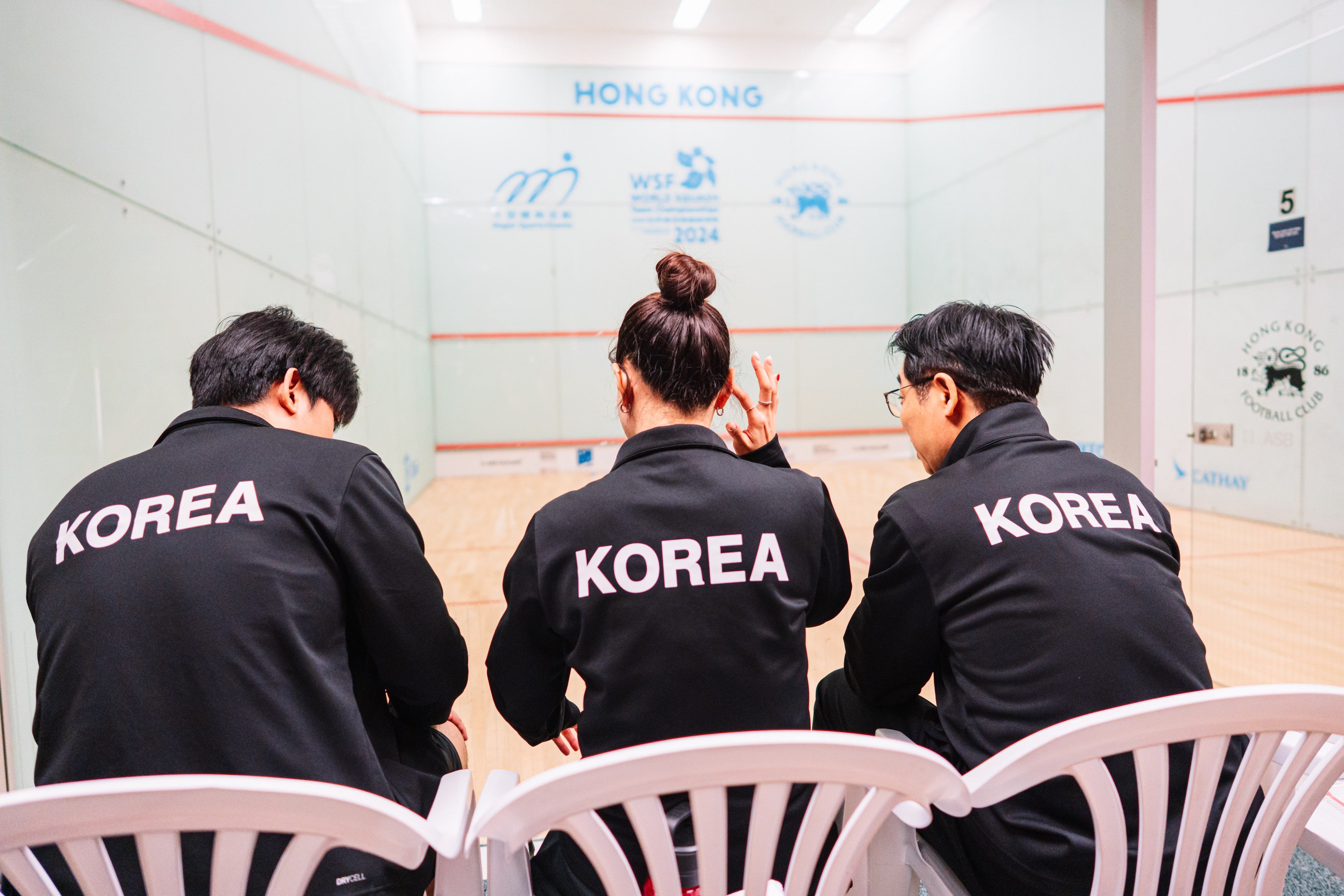

For Seojin Oh, a key figure in the South Korean junior team, the thrill of competing on the world stage in Houston was eye-opening: “The World Juniors was a great event and great experience for Korea squash. We targeted the bronze medal in the team tournament but didn’t expect to go to the final. It was amazing and an honour to go to the final. In Houston, we showed Korean squash to other countries and were so happy that squash-related people from all over the world became interested in Korean squash.”
Seojin’s pride is palpable, his words reflecting the joy of discovery, of realising that South Korea could stand tall among giants. But his statement also hints at a realisation that the comforts of the Korean system might be both a blessing and a curse.
“I also realised that the world wall is not ‘that’ high,” he said a phrase loaded with possibility and contradiction. The wall may not be high, but it still exists, a barrier defined not just by geography but by mindset.
It’s a double-edged sword that South Korean squash wields, one that grants security but risks stifling the very spirit that fuels greatness. The players are protected, but is it at a cost? Can one truly reach the summit of sport without the crucible of international competition, without being tested in the most demanding environments?
“The other side is that the money is all linked to competing at the Korean Games,” Sean Oh explains. “If a player takes a contract with a team, then joins the PSA and gets injured or for any reason has to miss the Games, they have to pay the money back to the team.
“So to go pro, compete in enough events to get a good ranking divisor (players must compete in around 10 events per year on the PSA Tour to qualify for a ranking divisor) and push to go up the rankings, there is a lot of risk.”
In the world of South Korean squash, every player knows the stakes: leave the comfort of home, test yourself against the world, and you risk it all. Stay, and you live well, free from the anxieties of rankings and results.

It is a difficult choice, laid bare by the peculiarities of politics, pride, and economics.
But for Jooyoung Na, the call of the world outside is strong. “I think I’m going to join a professional team in Korea but I also want to perform well as a professional player on the PSA Tour,” Na says, his ambition shining through.
“I also have the ambition to become the first Korean player to do well at the Asian Games and Olympics. It’s definitely very meaningful to me that squash has entered the Olympic Games. It’s a stage that every sports person dreams of, so I want to play in the Olympics.”
The Olympics, that grandest of stages, may indeed be the key that unlocks the door to the world for South Korean squash. “When I think about squash playing in the LA28 Olympics, it is very exciting,” Seojin Oh adds. “It’s my next goal to be a member of the squad playing squash there. So to achieve it, I need to be focused, practice, and participate in PSA events and get good results.”
For the wider South Korean squash community, the inclusion of squash in the Olympics could be transformative. “I think the Olympic Games could make a big change to squash in Korea,” Sean Oh says, his voice carrying a note of hope.
“I think we will see more young players coming into the sport—from the overly competitive sports like soccer, etc. More players should increase the level, and the success of the team in the World Juniors shows that we may have the talent here to compete at the world level. Add a good domestic earning potential and the possibility of competing at an Olympic Games, and squash becomes much more appealing than it has been in recent years.”
For Jooyoung Na and his generation, the question isn’t just about how good they can be; it’s about how far they’re willing to go to find out. The world outside waits, but to step out, they must first be willing to leave everything they know behind.
And so, the Korea conundrum remains: in a world where comfort is the ultimate currency, can ambition find a way?
The answer may well define the future of South Korean squash.
Latest News

Gohar: "I love breaking stereotypes"
Motherhood does not appear to have softened the ferocity of Nouran Gohar's ambition. Despite dirty diapers, fractured sleep patterns and doubting voices, her focus is clear: 'I will return to world no.1.'

StayInIt: Graduate League Squash
What happens when the U.S. College experience is over? Step into the world of the Graduate League Squash

Wonderful Woodliffe
Mark Woodliffe's recent World Masters wins set new records, defied repeated medical setbacks and continued an extraordinary family legacy.


