



By Mike Dale
Wales international Lowri Roberts has launched her own sports apparel brand to help boost athletes' body confidence — a struggle she knows only too well.
Roberts reached the world's top 100 for the first time in April last year and the following month was part of the Welsh team that earned bronze medals in the European Team Championships in Uster, Switzerland.
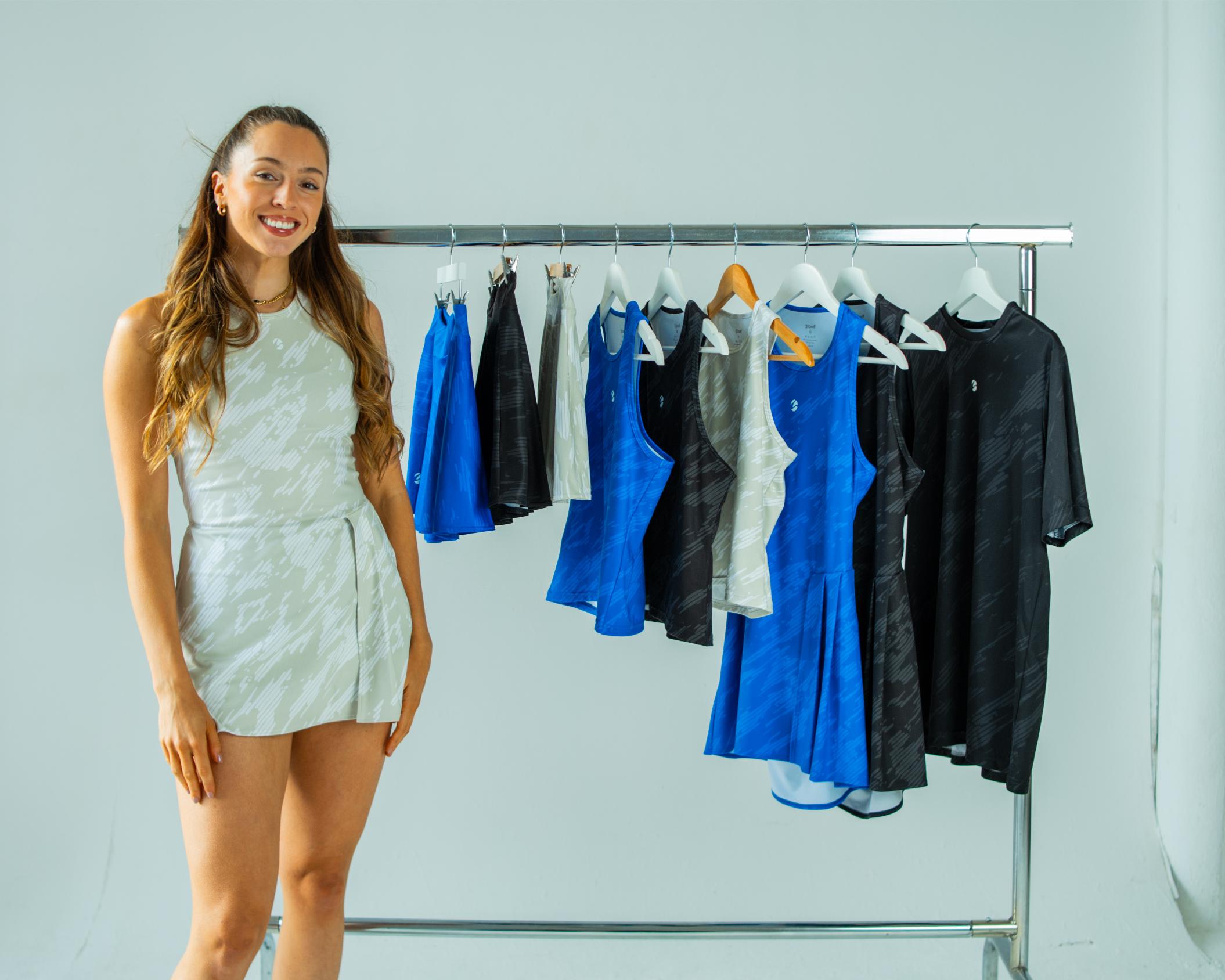
Now 27, as she approaches the peak of her athletic career, she's about to launch a new on-court clothing collection under her label LOWFF (a blend of her first two names, Lowri and Ffion, with a proud nod to the latter's Welsh heritage).
By her own admission, Roberts is currently in a "good place," but she is candid and honest in discussing the traumatic path that got her to this point.
She was aged just nine when diagnosed with anorexia, which was first spotted and reported by a cleaner at her primary school. Despite entering the support system, the issue soon spiralled.
A year later, she weighed just three and a half stone and was bed-bound. "One of the final straws was when they said I couldn't play squash any more," she tells Squash Player.
"The doctors said if I continued to play squash it was likely I would collapse. I wasn't allowed to walk anywhere. I had to be escorted to the bathroom. Yeah, it got quite bad..."
Roberts remembers being perplexed when first told that she was anorexic. She was given leaflets that outlined typical traits and behaviours of people with eating disorders — and she was astonished to see that many of them applied to her.
"I remember reading it and going, 'How do they know that I do that, when I barely recognise it myself?'" she says. "Wearing oversized clothing, eating food off side plates; I'm doing all those things!
"I didn't feel like there was anything wrong. I just felt that I didn't have an appetite. I didn't realise I looked like an anorexic person.
"Because they were telling me what was wrong with me, I almost went the other way [to justify the diagnosis] and got more and more ill.
"It spiralled then. As you get iller, your choices get taken away. Squash got taken away. The only thing I could control was how I ate and how I looked."
Recovery from that dark period was slow, delicate and non-linear. She later returned to the squash court and competed on the junior circuit all over Europe, before venturing on to the PSA Tour aged 18.
But a couple of years later, she stepped back from playing full-time. "It [anorexia] came back to a certain extent," she says. "I was on my own a lot more and I found going on court was too much.
"You put a lot of pressure on yourself and when you lose, you internalise it a lot more. You can't rationalise it. I spiralled a little bit — and I couldn't figure out a way out of that spiral."
Results were totally dictating her self-esteem and confidence levels and her eating disorder was returning as a way to exert some control.
With expert help from personal trainers and nutritionists, and "a lot of trial and error," she used the time away from competition to achieve a healthier balance between training and her diet.
She explains: "I put a lot of trust in the experts. They helped me understand that you should train to an extent you're happy with, and because you're working so hard the fuel [food] then helps you look and perform better. That took a lot of learning."
She adds: "Athletes want to look athletic and there's a culture around looking a certain way. Not training is not an option for athletes and I think it's the same with eating disorders. It quickly becomes 'not a choice'. It's just how you operate and function day-to-day.
"Athletes are looking for little ways to improve their game, so you think, 'If I shed a little bit of weight, I'll see real results from it.' You can understand how that kind of thing can turn into a hyper-fixation."
She relocated to Manchester and linked up with coach Josh Taylor, won her first PSA title at the Lexden RFC Open in August 2022, won another the following April in Normandie, France, and began her ascent up the rankings into double figures, where she now remains.
Roberts now refers to her anorexia in the past tense, but won't pretend there's no possibility of it ever returning. She explains that it's transitioned from "being something that people can visibly see is an issue" to "something I mentally have to keep an eye on."
Her family and closest friends are now good at spotting small trigger warnings that can manifest themselves if she's had a few bad days. Injuries that prevent her training can be particularly acute periods of mental discomfort. "Friends call me out and say, 'Do you realise you've been doing this?' Then I become aware and get it back in check," she explains.
"People with eating disorders are usually very, very driven," she adds. "It's about trying to divert that into the correct things — training well, eating well, fuelling your body correctly and working on the psychological side, rather than being purely results-driven.
"It's hard not to just focus on your ranking and results. Focusing on the things you can control and trying to relax on the results side is a big focus for me, but not something I've always been good at!"
Founding the LOWFF brand, with the help of designer and fellow squash player boyfriend Stephen Hearst, helps provide a better balance to life these days.
"Without setting specific targets, I just challenge myself to see what I can achieve and be the best version of a squash player that I can be, given everything I've gone through," she states. "For me, that's definitely a good place to be."