


Words: James Zug
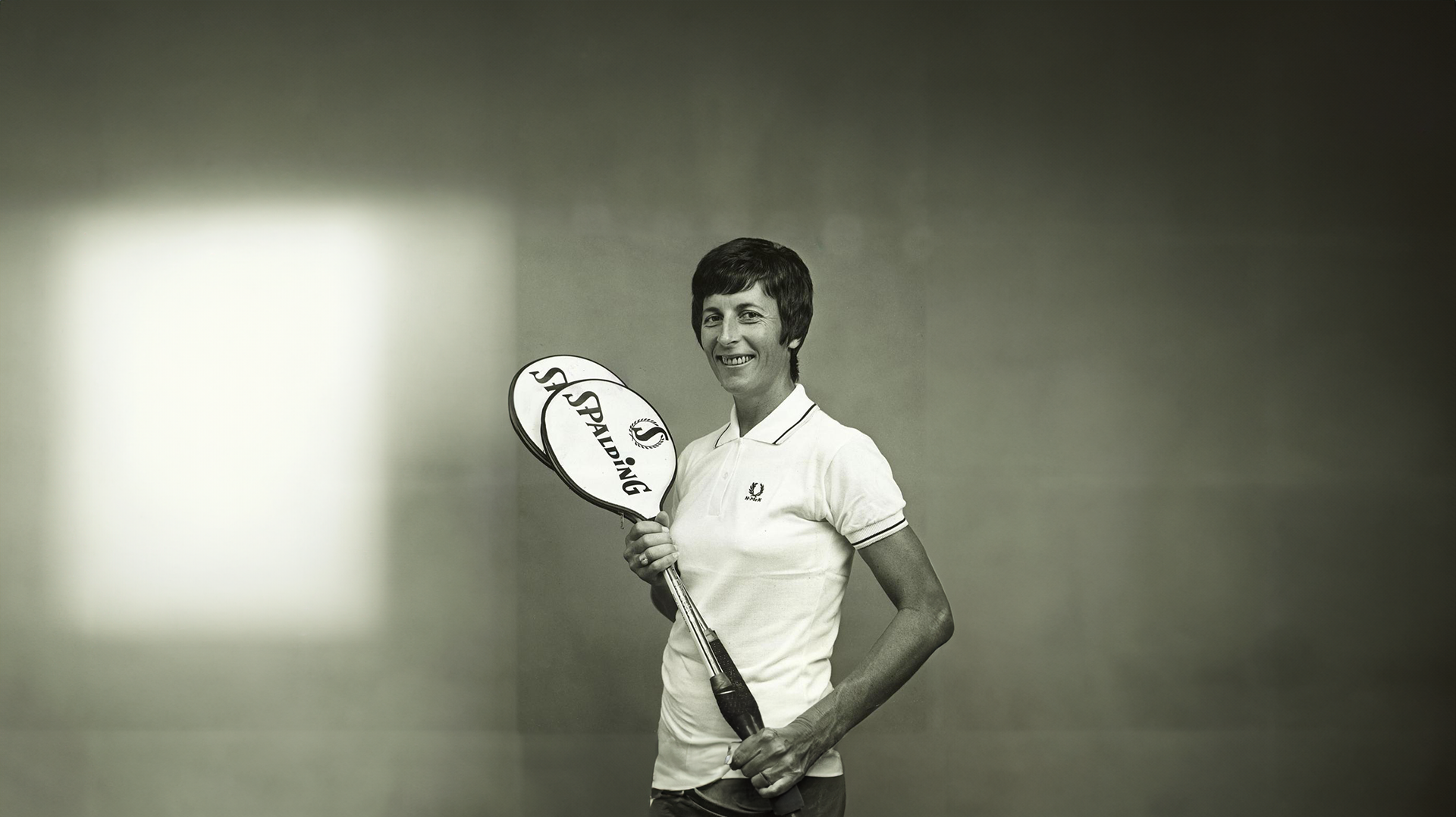
Earlier this month Heather McKay, one of the greatest players in the history of squash, turned 85 - squash historian James Zug reflects on her story.

Bungalow
The first thing I noticed when I visited Heather McKay at her house on Cameron Road in Queanbeyan is how unprepossessing it is.
The world’s greatest squash player lives in a semi-detached complex of white-faced, semi-detached bungalows on a quiet road right off Canberra Road, a busy, four-lane motorway.
Across the street, more or less, are the Queanbeyan Showgrounds and a few hundred yards away is the old downtown. Queanbeyan is no longer the isolated up-country village—sheep and cattle country—as it was when McKay grew up there, eighth in a string of eleven children, in the 1940s. Half a dozen miles away is downtown Canberra, the nation’s capital and today home to a half million residents. Queanbeyan is basically a suburb. McKay took me past a small garden and inside her home. A decade ago her husband Brian McKay died and McKay lived alone, but next door to her sister. Another sister lived down the road.
Five of the eleven Blundell children were still with us.
She gave me tea. She gave me a Tim-Tam, the famous Australian chocolate biscuit. She lived downstairs but showed me a room upstairs where she stored the flotsam and jetsam from her celebrated, unparalleled sporting career: plaques, pins, cups and bowls. Mostly, though, we sat on her blue couches by the window and chatted hour after hour.
At the end of July, she turned 85.
Still spellbound by squash, she was pointed; dartlike; definite; a diamond, radiant.

640
Heather Pamela Blundell McKay AO MBE (posterity: it is pronounced, as the papers used to say, like McKie or McHigh or rhymes with pie) is the world’s greatest athlete that most people haven’t heard of. She was, the New Yorker magazine said, a dynasty all to herself.
No sport has had a player who dominated so thoroughly for so long and at the same time withstood so many monthly and annual challenges. The closest maybe is Helen Wills Moody who a century ago went undefeated for nearly seven years in tennis, totalling 180 matches. Pro racquetball’s Kane Waselenchuk notched a 134-match streak that lasted three years. Certainly, squash hasn’t gotten close—no one at the top level has gone unbeaten for a fourth of McKay’s nineteen years.
Of course, Jahangir Khan’s mythical 555 wins is widely regarded as a joke (more like perhaps 180 straight victories in his three actual unbeaten years), but McKay’s is not. Just think: 1962 through 1981 and not losing a match once. The Guinness Book of World Records declares it to be the longest unbeaten run in squash history.
McKay lost twice in her tournament career: in 1960 to Yvonne West in the quarters of the New South Wales Championships (McKay had only been playing squash for a few months and, inexperienced, was up 2-0 and 8-2 in the third and then crashed.) The second was in February1962 on her first trip to Great Britain. She succumbed to Fran Marshall in the finals of the Scottish Open 9-7, 10-8, 6-9, 1-9, 9-4. There were three excuses for that loss in Edinburgh: she had brought only two racquets to Scotland and both of them broke in the final and she had to embarrassingly borrow a bat from an audience member; she had arrived in the country just ten days before and was still getting used to the English ball, the so-called Dunlop butyl, which was much spongier, softer and slower than the yellow-dot Australian ball; and she was still adjusting to travelling: she had never left Australia before.
Sports demand statistics. We enshrine certain numbers. Fans instantly know what we are referring to: 99.94 or 18 or 24. (Bradman, Nicklaus and Djokovic). Squash has utterly failed at numbers: we don’t have a good Grand Slam, and we don’t have reliable statistics before Howard Harding arrived on the scene in the 1990s.
When I was with McKay in Queanbeyan, I asked her if we could channel the diluvial of unbeaten years back into tournaments and then matches. We needed to discard the fake 555 number and instead promulgate a sum that set an authentic goal for all squash players.
She wasn’t reluctant but it wasn’t her style to brag. We ran through what she played each year: the annual state and national championships: she won fourteen straight Australian national championships (the event usually lasted a fortnight), fourteen straight Victorian Opens, the New South Wales Open year after year. Test matches against England. The annual trip to Great Britain and the warmups—North of England, South of England, Chichester, Scottish Open—and then the British. And a dozen events she played in North America, the two World Opens at the end. Let’s be conservative and underestimate: eight tournaments a year for 16 years.
That is fair. Mostly draws of 32, so five matches (some British Opens had six rounds). That equals 640.
This is the number that should be emblazoned in all our minds, the number that will never be beaten: Six. Four. Zero.

Gunslinger
The joke was that Heather McKay had one fundamental weakness: she had a terrible return of serve. It was rusty. She never got to use it.
“I also believe,” wrote Herbert Warren Wind, one of the great sportswriters of the twentieth century, and the man who coined the term the Grand Slam, “that she is one of the finest athletes I have ever seen.” Her streak, Wind said, “was perhaps incomparable in the long history of sports.”
What was it like to play against Heather McKay? At five foot six she was of average height, but of incredible athleticism and mental toughness: cool as a cobra.
In the late 1970s, Frank Satterthwaite, a top American pro, trained with and later played an exhibition with McKay at the University Club of New York. He devoted a chapter to McKay in his splendid 1979 memoir, The Three-Wall Nick and Other Angles. He was impressed with her movement.
“She has super acceleration and when caught off base she can suddenly shift directions and recover from a misstep with an ease no other woman seems capable of.”
Satterthwaite also noticed confidence.
“She’s all business on the court, but if you catch a glimpse of her face while she is hitting, you can see the beginnings of a little smile. The smile of a hunter about to pull the trigger? Between hits she walks (never runs) to the T with a rolling ‘jock’s gait,’ shoulders thrown back and elbows out like a gunslinger. It’s an appealing toe-dragging swagger and I’m sure she’s unaware of it.”
“Her court manner is calm and pleasant,” wrote Wind, “and one receives the impression that, like many Australians, she is without a grain of affection in her makeup.”
Like everyone, Wind was fascinated by her abilities. “Her racquet work was sound, stylish and decisive,” he decided. “She got to the ball faster, hit her shots more sharply and took more to disguise her intentions. After all her campaigns, she still responds to competition and is vastly aided by a self-critical attitude common to champions; when she plays a batch of loose points, it miffs her.”
Mike Way, the Harvard coach, has a theory about expectations and pressure. When you are on paper the much better player, it is hard to play someone who is supposed to be worse than you—you have a lot to lose, they have no pressure. Way calls that an Arrow Down match.
Heather McKay spent almost her entire career in the unenviable position of playing Arrow Down matches.
“They think I won three-love easy,” she told me, “but it wasn’t always easy.”
I calculated her appearances in the 16 straight British Women’s Squash Championships (in 1974 it permitted professionals to enter, becoming the British Open). She never granted quarter. How many matches at the British championships did she record a 9-0 score? You aren’t going to believe it: 104 times in 16 tournaments she had a bagel game.
She had a rare talent for concentration. She won the British at clubs all over greater London— Lansdowne Club (with its notoriously warm courts, close to the swimming pool), the Royal Aero Club, the BP Club in Lower Sydenham, the last three at Wembley. It wasn’t that she just beat the same opponent. She faced ten different women in the British Open finals: Fran Marshall four times; Anna Craven-Smith three; and once against Bev Johnson, Jenny Irving, Kathy Malan, Cecile Fleming, Sue Cogswell, Marion Jackman, Sue Newman and Barbara Wall.
In the mid-1960s she worked hard against Craven-Smith, losing a game to the Englishwoman in the semis in 1964 and later twice going to overtime in a game against her in the finals.
“I had some rippers against Anna,” she told me. “I mean, she used to push me.”
But, still, all the nine loves.
“You must approach each match with a generous supply of killer instinct tucked in among your talents,” she wrote in Heather McKay’s Complete Book of Squash. “It’s realising that your job is not to give your opponent a pleasant run around the court.”
In 1968 she recorded twelve bagel games in her five matches, including 9-0, 9-0, 9-0 victories in the semis and finals. The final lasted eighteen minutes. A reporter wrote afterwards, “Miss Johnson maintained several long rallies.”
In Sheffield in 1979 McKay won her second World Open. She was 38. Will any 38-year-old ever again win a world title? She lost two games in her five matches, both opening games in the semis and finals before she stormed back. She also recorded three 9-0 games in the tournament.
Consider her last British Open, No.16 in 1977. She was 36. Ultimate Arrow Down moment. She won her first two matches at love; she took the next two more losing just two points total; and she gave up just six points in the final. Only in the semis did she really struggle, losing a third game against Sue Newman, 9-5. It was the first game she had lost in the British Open since 1964.
She blanked Newman in the fourth. It miffs her.

Jack Dempsey
One of the spectacular stretches in McKay’s career is almost forgotten: her decade in North America.
In 1974, when the British Championships went open, McKay turned pro. A year later Brian and Heather moved literally around the world. They stayed for ten years. They worked at the new Toronto Squash Club, a 17 court (15 hardball singles, one softball singles, one doubles) facility. Brian was the manager; Heather was the coach—perhaps the first woman in the world to work full-time as a squash teaching professional.
McKay had a colossal impact on squash in North America. She won the 1976 Canadian National Singles. She came regularly down to the U.S. Her initial foray was in January 1977 when she flew to New York to headline the Bancroft Open. It was the first time an American women’s tournament had offered prize money. The Bancroft was held at Uptown, the infamous new, fourteen-court public squash club on the Upper East Side. McKay beat Sue Newman in the finals in three.
“Her racquet, body and mental control are supreme,” wrote Bobby Lehman after the seminal tournament, “and she could be counted on time and again to quell any hope that her opponents might have.”
The total prize money was $6,500; McKay walked away with $2,000, the largest payday she would ever get in squash. (The winner’s prize of the first British Open in 1974 was £50; her last British Open in 1977 earned her £100; the World Open in Brisbane in 1976 netted her $2,000 Australian.)
The thing people remembered the most from the first Bancroft was not the matches but the creation of the draw. In a publicity stunt, Jack Dempsey helped pull names on slips out of a silver bowl. Dempsey, the former world heavyweight boxing champion and Roaring Twenties legend, was eighty-one, leaning on a cane and in failing health, but he was still more of a media draw than McKay.
The tournament promoter got a raft of exposure, including a piece in the New York Times—“Dempsey Lends His Weight by Conducting Draw for Women’s Squash Racquets Event”—for hauling the Manassa Mauler up to Uptown. A reporter asked Dempsey if he ever played squash. “No,” he said, “but I will if you want me to.”
“Her visit stirred up immense interest,” wrote Herbert Warren Wind in the New Yorker.
She came back. She won the Bancroft Open three straight years. She captured the 1978 Viva International, held at the Manhattan Squash Club; the title sponsor was a women’s pornographic magazine published by the owner of Penthouse. She won the U.S. National Singles in 1979—it was big news when Barbara Maltby took a game off McKay in the finals—15-7, 9-15, 15-8, 15- 6. McKay “was hitting the tin and making unforced errors,” wrote Carole Dicker afterwards.
“Barbara continued the pressure, driving the ball well and playing exacting, sharp-angled roll corners and captured the game.”
McKay earned $500 for first place. Naturally she played hardball doubles. Her first time on court was actually in 1962 at the Edinburgh Sports Club, which has a proper doubles court. She won the Canadian National Doubles in 1985 and the U.S. National Doubles in 1984 and 1985 playing the left wall with a Canadian, Barbara Savage. In 1984 they had a tight final in the States, winning 18-15, 15-8, 16- 19, 15-8 over Karen Kelso and Joyce Davenport. In 1985 it was even tighter: they won their semis but barely, after being down 12-7 in the third, score tied at one-all and saving a game ball at 15-all; and giving up a game in a four-game final.
“I loved squash doubles,” McKay told me.
“It was different. I enjoyed playing with someone else. It was a team. You were a partner. I always said that hockey kept me sane for sport. It was the same for doubles. You’ve got someone else. In hockey, if you screw up you can blame the other ten.”

Keep Eye on Ball
Heather McKay was an eye-puckeringly impressive athlete in part because of her family.
They’ve lived in Queanbeyan since 1826. Her father Frank Blundell, who worked as a baker on a shift from ten in the evening to five in the morning, excelled at rugby league (fullback or wing) and almost was selected for Australia. His sister played cricket and hockey against touring English sides; another Blundell aunt was a famous fast bowler. In the 1950s sports were all- consuming in Australia, especially after the 1956 Melbourne Games. Heather’s older siblings were very good. Pat, one of her older siblings, didn’t play sport but the rest did: Kay excelled in tennis, Kenny was good at cricket, three sisters played field hockey at a high level and another sister won the local club championship fourteen times, had two children get golf scholarships to U.S. colleges and a grandson who currently plays off plus four.
As a teenager, Heather McKay excelled at tennis and hockey. She was a left inner on the hockey team. She twice was selected to play hockey for Australia. Accidentally, she found squash. She finished school at fifteen. Seventeen and on holiday in Sydney, she was walking on Manly Beach and bumped into a pay-to-play squash club. She rented sneakers and had a hit.
Two years later she was working as a clerk at Mr. Gray’s news agency and stationery store on Monaro Street (a ten-minute walk from her current home). In 1959 a car dealer in Queanbeyan added two courts to his service station (the Australian squash boom was a boom), and McKay wandered in looking for something to occupy herself in hockey’s off-season.
Over Easter Week 1960 she won her first tournament in Wollongong (a women’s draw and a junior draw). After the tournament, she chatted with the president of Squash Australia. He complimented her boasts. She asked him what that meant—she had never heard of the shot. In June she went to Sydney and lost to West in the New South Wales Championships.
Hashim Khan visited Canberra later that year on a tour, and she twice hit with the best player in the world.
“Hashim stressed,” she later said, “that I should go for winners more often when I was in a position to put the ball away.” Keep eye on ball.
(A delightful coda: sixteen years later they met for the first time since, to play an exhibition in Toronto. Hashim remembered hitting with the shy 19-year-old in Canberra. Then he proceeded to beat her in the exhibition: “Hashim always goes for winners,” McKay said.)
By the time her one-year anniversary of starting squash had rolled around, she had won the Australian women’s championships. This was high level—at the time Australia was one of the top squash nations in the world. “When I came back home from the Australian championships, I sat down with my mum and dad,” she told me, “and made the decision: did I want to continue with squash? If I did, I had to move to Sydney.”
In 1961 she got a job as a receptionist at the eight-court Bellevue Hill Squash Club in Sydney (she couldn’t work as a teaching professional because all women’s squash tournaments around the world were amateur- only, and either she accepted money for coaching or she played tournaments). Bellevue Hill had a café and a pool. For the next four years she lived at a boardinghouse down the road. She moonlighted as a dispatcher for a taxi company.
A year later she made her famous foray to Great Britain. It was the first time she had left the country. Her family and friends in Queanbeyan raised £231 for her airfare to London. After her tournaments up north, she spent two weeks in London training with Dardir El Barkary, focusing on her footwork. Then she won the British. Not too many people commence with an entirely new sport at age eighteen and become the de facto world champion at twenty.
She never got complacent.
Janet Morgan changed her backhand grip. In Sydney she trained with Keith Walker, working on her dropshots. She was not just a generationally-good athlete, but she worked hard. She didn’t rely on talent: she practiced. She played against the top men in town. She developed to the point where Herbert Warren Wind said that “the handsome, functional crispness of her strokes” reminded him of Ben Hogan’s golf swing.
She trained ferociously. She skipped rope. She jogged five mornings a week. She ran steps. She did wind sprints and court sprints. She lifted weights. She hopped on stationary bikes. Crucially, she played other sports. She played hockey every off-season, even when she moved to Canada. She played tennis. And she had luck—besides two cracked ribs, she amazingly had no significant injuries during her entire squash career.
At Bellevue Hill, she met Brian McKay. He was a fitter and turner, a lathe operator, who taught squash there in the evenings and weekends. They got married in December 1965; moved to Dickson Squash Center in Canberra in 1969; then Wavell Heights Squash Club in Brisbane in 1972. (Two of these three clubs are now closed; the courts at the Queanbeyan service station are still there but haven’t been used in decades. Boom, then bust.)
Professionally, they were a two-some. They worked together, managing the same clubs for nearly twenty years. They sometimes went on the road, going to small towns in the outback to give exhibitions. They once did this roadshow for six straight weeks. They did the roadshow on the road in Pakistan, South Africa, Denmark. Marriage did something else for McKay. When she was twenty, living in Sydney, she became a pack-a-day cigarette smoker. Everyone smoked. She smoked in the dressing room before matches. Then she married Brian McKay and, cold turkey, she quit.

Wailing in Despair
One perception today is that Heather McKay was just so much better that it was painless for her, that she just chopped everyone without a thought. A cakewalk. But it wasn’t that way. McKay’s parents and siblings followed her progress each February in the British championships via two methods.
The Canberra Times reported on her matches.
“For a moment it was touch and go, we were really battling,” the Canberra Times quoted her in 1967, after she beat Anna Craven-Smith 9-1, 10-8, 9-6.
“It was the hardest match I’ve played. It was a terrible match. We seemed to have a tremendous number of lets—this was the tension I supposed. After a match of this kind there’s a great feeling of satisfaction. I’ve got quite a few good years left in me yet. The best thrill is when you triumph over something. Of course I still enjoy taking the title but not as much as the first time.”
Then the reporter added this observation: “Several times during the second and third sets, Mrs MacKay wailed in despair as she dropped shots and gave away vital points. She lost her composure several times and her placement suffered.”
McKay wailing in despair? If you knew her as a teenager, it wasn’t surprising. Much like Roger Federer, she had a temper that needed to be mastered.
“I used to have my own troubles with crankiness,” she wrote in her 1977 book Heather McKay’s Complete Book of Squash.
“I broke rackets against the court walls when I was new to the game, and I turned the air blue with some choice profanity. I knew all the swear words. I grew up with five brothers and I could swear with the best of them. But I learned fairly soon that my nasty moods were hurting my game, and I learned to control them.”
Despite or because of her unbeaten run, she would get asked every February in London if it was her last year coming for British Open.
In 1971 she tied Janet Morgan for the most ever titles, at ten (ever since her first visit to London in 1962, she had billeted at Morgan’s home in Surrey—“a second mum” McKay called her).
“So many people have said that I would be silly to quit now. I feel that I have got to come back next year—with my husband. Then I might call it quits.”
But the competitive juices were still there and she kept returning. In 1972, she broke the record. Morgan gave her an engraved bowl.
It looked easy: “Last night Mrs McKay made no more than a half a dozen unforced errors,” the Canberra Times reported, “and only at the end did she show any sign of being human. She took an 8-0 love lead into the third game, then twice hit carelessly into the tin before winding up the match in champion style.”
In her last year, 1977, the Canberra Times declared: “She believed she has become more nervous and strained over the past few years.”
The other way her family heard about her victories was by the telephone. Each year after the finals, McKay would call long-distance to Queanbeyan from a landline near the bar at the Lansdowne Club. She would tell them what had happened during the week and her triumph in the final. Sixteen phone calls.
Disappear on a Dark Night
While in Toronto, McKay, ever keen for challenges, took up racquetball. The game was at its apogee in the early 1980s, tens of thousands of courts all over the continent, wealthy pro tours, an unprecedented spurt of attention. It took McKay just over two years to become world champion in squash. It took half that time for her to do the same in racquetball. No half measures.
In her late thirties she started playing racquetball competitively. A women’s pro tour sprang up in 1980 and she captured the women’s pro tour world title in 1980, 1981 and 1984. In her six seasons on tour, she ended the year ranked No.1 three years and No.2 in two others (No.7 in her last year in 1985).
She played in 43 pro events, reaching the finals in 37 and winning 20; she compiled a career record of 118-20. Yes, she lost matches—20 of them. She also lassoed a slew of amateur singles and doubles events, by one count nine U.S. national titles and seven Canadian national titles.
In April 1980 Sports Illustrated, the American weekly sports magazine, ran a major feature on McKay’s switch of sports. “McKay is one of the most extraordinary athletes of our time,” Jim Kaplan wrote. “Astounding the racquetballers, she beats them at their own game by mixing in squash strategy. Standing near midcourt—pigeon-toed and bowlegged, swaggering a little—she directs traffic. A shot to one side. A shot to the other. A cross-court. A multiwall shot. Scrambling wildly, the opponent is pressed merely to keep the ball in play. Eventually McKay takes the rally with a quick shot to an opening.”
The article also contained one of the most memorable all-time spousal quotations. Kaplan interviewed Brian McKay who commented about his perception of Heather’s lack of court speed: “She couldn’t disappear on a dark night.”
In Queanbeyan, I asked Heather about Brian’s infamous quote. “I think we might have had words over that,” she quickly said. “I took him to task.”
From Alaska to Louisiana, Oregon to Missouri, McKay travelled to racquetball tournaments across the continent.
“I made a lot of friends,” she said. “I was always ‘the squash player.’ That is what they said. I was the squash player who had come to play racquetball. They accepted me eventually. It was not as challenging mentally as squash. The game is working your opponent and hitting hard. I was so used to the tin that the other top girls would hit it low but I instinctively wouldn’t. And I never got comfortable with the ceiling shot.”
She’s been inducted into three halls of fame in the sport: in 1997 in the USA Racquetball Hall of Fame; in 2021 in the Ladies Pro Racquetball Hall of Fame; and in 2022 in the Canadian Racquetball Hall of Fame.
“McKay wanted to be the best she could be, while playing with honesty and integrity,” reads her Canadian Racquetball Hall of Fame inscription.
“She was gracious off the court, and focused and unwavering on the court. As a legendary multi-sport athlete, McKay is known as one of the most impactful athletes in the history of sport. Her integrity as a competitor, her attention to training, her unparalleled competition focus and her commitment to sport development left a lasting legacy both in Canada and around the world.”
McKay never played racquetball after leaving Canada. Forty years on now, the sojourn in North America were halcyon days for her, redolent with memories of early morning jogs on the boardwalk along Lake Ontario or a Bacardi-and-Coke after a day of teaching.
“Those ten years were really good,” McKay said, “because the lifestyle wasn’t that much different from Australia. It was just the weather.” Ten years ago, after Brian McKay died, Heather returned to Canada and reunited with dozens of old friends and held an informal memorial service for Brian at the Toronto Cricket Club.
Lion at Rest
McKay estimates she’s in ten halls of fame. I stopped counting at fifteen. In November 2026 she will be inducted into the U.S. Squash Hall of Fame
McKay is a squash lifer. The game possesses a sacramental sensibility for her. She entered four World Masters championships. She won the world 45+ in 1987 and 1990 and 50+ in 1993 and 1995. Another way to think about it is that from Fran Marshall in 1962, Heather McKay didn’t lose a tournament match until she well and truly retired in 1995.
After returning from Toronto, she worked for 13 years (some part-time) at the Australian Institute of Sport in Brisbane. She coached. Driving a sixteen-seater bus in Europe, she led Aussie players at the world junior championships and gave them their first introductions to the pro tour. She became a beloved, touchstone figure to the next generation of Aussies. Sarah Fitz-Gerald, the five-time world champion, counts her as one of her most important mentors—McKay chaperoned Fitz’s first trips overseas—and to this day she acts as a go-between for McKay and the squash world.
McKay and Brian had a group of Aussie squash friends, including Jenny Irving, that they’d annually holiday with for a week. In March this year she went to the Australian Open in Brisbane where she was inducted into the PSA Hall of Fame.
A sportswoman nonpareil, she played masters hockey upon returning from Canada. She fell back into tennis, winning nine Australian masters titles. She travelled the world leading Australia’s masters team in the world team championships—Bad Hofgastein in Austria, Philadelphia, Perth—once guiding them to a 60+ world team title. In 2001 she captured the women’s world’s 60+ singles title, surviving a match point in the third-set tiebreaker.
How many people do you know have won a world title in three different sports? She reluctantly gave up tennis at age eighty-two. “If I had one regret in my sporting career,” she told me, “it was not being an Olympian, of not having the chance to be an Olympian. You always think that if you are a sporting person.”
Physically, McKay is in fine fettle. She no longer has a bad back. She has had her left knee replaced. She bikes on a stationary bike and in her garage lifts weights. She walks. Every Sunday she and her sister go on a long walk and then have a coffee afterwards. She has never seriously played golf. “It takes too long,” she said. “I didn’t have the time when I was playing squash. When I was done with squash, I went back to tennis. In golf, I couldn’t hit it. But oh, where did it go? I loved the driving, loved the putting, but the in between stuff didn’t do much for me.”
Heather McKay is pointing towards going to watch squash in Brisbane in 2032. She’ll turn ninety-two during those Olympics.
“I often think, you know, I didn’t make much money,” she told me when I was walking out of her Queanbeyan bungalow, “but I’ve had a great life out of squash. A great life.”