


Chris Truswell is the man tasked with ensuring squash's Olympic debut goes off without a hitch. Whilst this sounds like an unenviably pressurised role, he is amply experienced and still has over two years until the Universal Studios gates open and the LA28 glass court is revealed to the world.
Squash Player spoke to Truswell just a week after he relocated to the Los Angeles offices for his post as Squash Sport Manager for the LA28 Olympic and Paralympic Games.
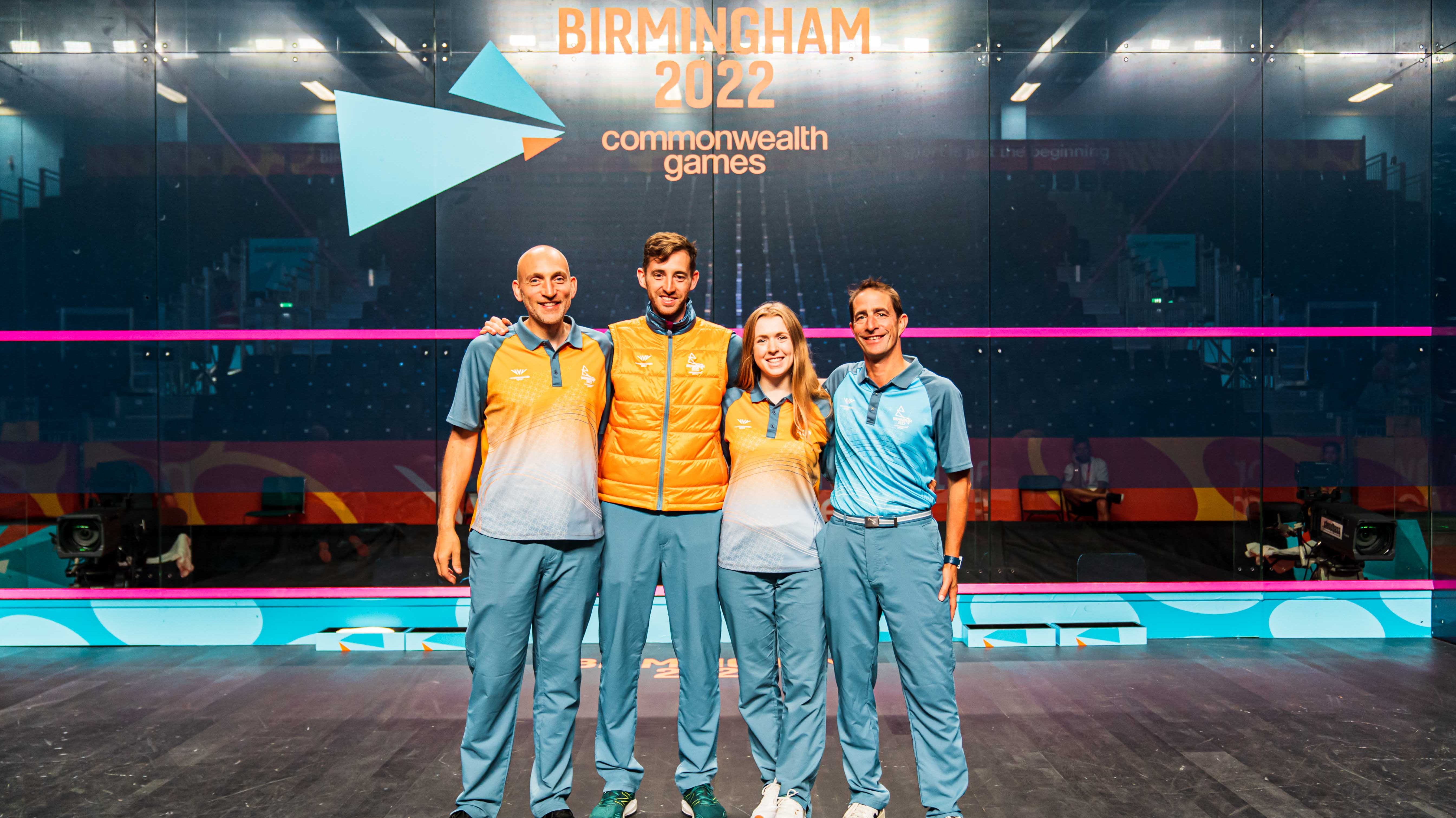
Truswell — who's from Staffordshire, England — is Director of Events at Squash Canada and was previously Squash Tournament Director at the 2022 Commonwealth Games in Birmingham.
As a pro squash player, he reached a career-high world ranking of no.116 before transitioning into sport administration with England Squash and the PSA.
 Truswell, second from left, during the 2022 Commonwealth Games
SP: Chris, with over two years until LA28, what are the main priorities at this early stage of preparation?
CT: The sport delivery for squash is the most straight-forward part, but there is much more going on behind the scenes. Our main priorities are the ongoing operational and logistical planning for every event, which is a phased and iterative process.
Currently we are working through venue refinements to ensure every function has the necessary space, client areas and flows, which are reviewed with the International Olympic Committee.
SP: Give us an idea of the logistical challenges of holding the event in a gigantic working theme park?
CT: As you can imagine, Universal is used to managing complex operations as an iconic and fully functioning film set.
We are working closely with their teams to ensure our plans have minimal disruption to their daily operations while still meeting all competition requirements. For example, we can't take the entire space offline at once, so we will take over different areas in a staged approach while the temporary installation takes place before Games-time.
SP: How wide is your remit? Does it include transport, ticketing, players' accommodation etc?
CT: The Organising Committee for each edition of the Olympic and Paralympic Games is made up of different 'functional areas' who are specialists in their area and responsible for delivering that service. e.g. ticketing, transport, accreditation, medical, tech, broadcast, security, etc.
Each functional area works closely with each sport manager to ensure sport-specific requirements are accounted for in their workstreams.
So, although planning is centralised, there is constant cross-function collaboration and my remit includes leading on the squash-specific requirements of each of the functional area plans, as well as maintaining an ongoing relationship with World Squash for when we require approval of certain milestones and decisions including the venue design, sport equipment, workforce planning, athlete services, competition and training schedules, and more.
I'm here to advocate for squash and make sure the event lives up to the anticipation and build up!
In comparison to a PSA event, for example, it's a totally different way of working and requires some adaptions.
SP: Give us an idea of what the venue — the Comcast Universal Squash Center at Universal Studios — will look like for visitors.
CT: The competition court will be built in the Courthouse Square lot, in front of the Courthouse, one of Hollywood’s most iconic and recognisable backdrops in movies like To Kill a Mockingbird and Back to The Future.
SP: What unique spectacles can squash fans expect at the venue which will differ from a normal PSA event?
CT: What could be more LA than staging a sport on a real-life film set? It’s truly a once-in-alifetime opportunity for both athletes and fans. We’re still working through the specifics of what the spectator experience will look like, but without a doubt it’ll be unforgettable.
SP: How much does the schedule — just one court, and a relatively small number of matches stretched over 10 nights — make things harder or easier for you as the organiser?
CT: A single evening session over 10 nights gives players more recovery and helps ensure optimal competition conditions, from temperature to lighting. It also supports Universal’s daily operations, since our sessions will begin after the park closes.
There are trade-offs; one court and one session a day make operations more straightforward than turning the venue over multiple times, but they could also lead to some late finishes.
At the end of the day, the most important part is for athletes and spectators to have an incredible experience, and these plans support that.
SP: We hear there could be a squash court at the athletes' village. Tell us a bit more about that.
CT: Yes, players will have access to a practice court in the Olympic Village which will be set up in one of the sports halls. They’ll be able to train within walking distance of their accommodations, with dining and recovery facilities nearby, making it a very convenient set-up.
SP: On a personal level, how do you cope with the pressure and expectation of successfully pulling off the biggest tournament in our sport's history?
CT: It's really exciting to be involved with the planning and delivery of squash's Olympic debut and I'm not thinking too much about the pressure from within the squash world to get it right.
There are a lot of experienced people on the LA28 team who have delivered multiple Olympic Games, so I'm learning from their shared experiences all the time.
Although we are still two years out, my experience in the same role at the Birmingham 2022 Commonwealth Games has been invaluable. The ways of working are very similar, and I know from experience that all the pieces eventually come together – B2022 worked out pretty well!
My focus is on making the player experience as seamless as possible, which will hopefully lead to some amazing matches for the spectators who have travelled from far and wide to witness this iconic moment.