





Squash's long, long road to LA28
By Mike Dale
We’re in!
These are words squash has heard before, of course – but this time, it’s real.
No last-minute power broking, technicalities or corridor chicanery can stop us now. LA28 will feature four glass walls, a little rubber ball and squash’s greatest gladiators showcasing our sport, with the world watching.
When news first broke of the LA28 organising committee proposing to add five sports to the Olympic programme, there was astonishment.
Cricket, with its billions of Indian fanatics (and potential customers for advertisers), had looked favourites for inclusion. Flag football, with heavy backing from the NFL, had also been hotly-tipped. But with a purported 10,500 ceiling placed on the total number of athletes participating at the Games, there was little expectation that anything more than one or two additional sports would be added.
Few expected five – and even fewer had predicted that squash would be one of them.
Squash has launched seven ‘official’ Olympic bids since 1990, and a handful of others which were essentially discontinued early in the process after it was made clear that there was no chance of success.
The process is expensive, back- breaking, complex and clouded in a dark web of politics, power broking, lobbying, vested interests and quid pro quos.
Squash has hit the jackpot at the seventh time of asking – and those in charge deserve huge praise for navigating these choppy waters and forming the key strategic relationships which have finally allowed our sport to dock itself into the IOC’s Olympic port.
The role of Mark Walter – the man responsible for squash’s first ever $1million tournament prize pot and investor in the commercial arm of the PSA – cannot be under-estimated. As owner of the LA Dodgers, whose stadium is being used for baseball and softball at the Games, he has the influence with the hosts’ organising committee that previous squash bids have lacked.
Another influential figure was Brian Roberts. He is chairman and CEO of US media giants Comcast, the world’s second largest broadcasting and cable TV company and America’s biggest internet service provider. Comcast own NBC – the US broadcast rights holders for the Olympic Games.
Roberts was a very good squash player in his younger days, winning multiple medals at the Maccabiah Games. He and his wife Aileen were founding donors of the Arlen Specter Squash Center in their hometown of Philadelphia – the headquarters of US Squash and venue for the US Open. As head of the host nation’s Games broadcaster, he is a man the IOC will listen to.
The WSF, PSA and US Squash formed key alliances with the right people in the right places at the right time. That’s how the game works, and finally, after almost four decades of trying, we have played it right.
Many squash administrators before them have strived – at great expense and personal sacrifice – to prize open the Olympic door. They have stated squash’s case steadfastly and passionately and ridden the waves of optimism and crashing disappointment.
Here, Squash Player re-visits the pain of the past through the eyes of those who donned their suits, boarded planes, pressed the flesh, rehearsed their speeches and, afterwards, sat desolately in a hotel bar far from home and wondered where it all went wrong.
Their toil and optimism may have seemed shatteringly fruitless at the time, but it has gradually moved us forward into the position we’re in today – proudly bearing our new status as an official Olympic sport.


1992 – Barcelona
Squash’s first flirtation with the Olympics came in the build-up to Barcelona 1992.
The process then was very different to today’s structured circuit of global conferences, lobbying and voting – and yet, in many ways, very little has changed in the way that sports are either embraced into the inner circle or brutally frozen out.
Squash was also very different in the 1980s. Although thriving at recreational level, it failed to captivate as a TV spectacle – with the ball difficult to follow and the courts failing to captivate.
The WSF was then known as the International Squash Rackets Association (ISRF). It was run by a committee of volunteers until the appointment of Edward ‘Ted’ Wallbutton as its first chief executive in 1990.
The IOC was different back then too. There was no formal way of new sports applying to get into the Olympics; the process relied heavily on attracting the interest of its all-powerful Spanish president, Juan Antonio Samaranch.
Squash’s first official ‘bid’ was to become an exhibition sport in the 1992 Games, the hope being that exhibition status would lead to inclusion in the Games themselves in future years.
Juan Dominguez Hocking was squash’s key insider – he was president of the European and Spanish squash federations and, from 1987, was head of the Spanish Olympic committee.
He and the ISRF produced a brochure extolling the strength of squash in Spain and why it deserved to be included in the programme for 1992. It said squash in Spain had grown “in spectacular fashion” to 200 clubs, 1,000 courts and around 100,000 players. They rather fancifully projected that figure would reach one million by 1992.
Spain, it boasted, had hosted the 1985 European Team Championships in Barcelona and the 1986 and 1987 Spanish Open, in which Jahangir Khan had played (he won them both, of course – they were part of his famous world-record run of 555 consecutive victories).
However, Barcelona was to be the start of a sequence of Olympic rejections which would be repeated over the following 36 years.
Three exhibition sports were selected: basque pelota, roller hockey and taekwondo.
Samaranch had played roller hockey at college and had founded their world championships himself in the 1950s. Taekwondo getting in was no coincidence either: IOC vice-president Kim Un-yong also happened to be the president of the Korean Taekwondo Federation (his career was to end in disgrace 17 years later when he was arrested for embezzlement and bribery and sentenced to two-and-a-half years in prison). Looking back, Wallbutton reflects with a smile: “That’s just how it was in those days.”


1996 – Atlanta
The period after Barcelona saw little scope for new sports to jostle their way on to the Olympic roster. The Games were commercially successful by now and inclusion on the Olympic programme was becoming lucrative, so existing Olympic sports started reinforcing their own positions by adding new disciplines.
At Atlanta, eight new events made their debuts, but all were just alternative disciplines of sports already on the programme (softball, beach volleyball, mountain biking, women’s football, lightweight rowing, women’s swimming, women’s fencing and team rhythmic gymnastics).
2000 – Sydney
At Sydney 2000, squash had a slight glimmer of hope. Wallbutton, Hocking and Tunku Imran – president of the Olympic Council of Malaysia and a firm squash supporter – racked up the air miles visiting key IOC figures and impressing upon them squash’s attributes for inclusion.
But the process of getting in remained incredibly difficult to navigate and straight answers were elusive. Wallbutton remembers: “You were never really told that the door was closed. We made various visits to Lausanne (IOC headquarters] and we had meetings with Samaranch and the whole committee. Samaranch said great things about squash and what a wonderful bid we’d put in. He shook our hands and left the room, but we made no progress.”
The Sydney bid, Wallbutton believes, was undermined by a lack of effective pressure applied by squash authorities and supporters in Australia. He recalls: “Local lobbying accounts for a huge amount. If a host nation really wants a sport, they can put a fair amount of pressure on the IOC and I don’t think enough was exerted by the host nation.
“With squash being very big in Australia, it was our best chance. In my opinion, Squash Australia dropped the ball. My view is that if we’d had a Mark Walter in Australia before the 2000 Olympics in Sydney, we’d have been in the Games 23 years ago.
“That’s what it takes. It takes local pressure. That’s what it’s all been about in Los Angeles. That’s what it would have taken in Australia, but the right person wasn’t there at the right time.”
In the end, taekwondo (Kim Un-yong’s baby) and triathlon joined the Sydney programme and the self-protection of existing sports continued with synchronised diving, trampoline, women’s weightlifting, modern pentathlon and pole vault all beefing up their respective sports’ power bases.
2004 – Athens
By the time Athens 2004 rolled around, the WSF had been boosted by the appointment of Susie Simcock as president – but even her persuasive powers couldn’t unlock the doors. It was a closed shop – and that applied to Beijing 2008 as well, despite the retirement of Samaranch in 2001 and his successor Jacques Rogge’s introduction of a more structured process.
No new sports were added in Beijing, but once again, existing sports slotted in new disciplines under their own umbrellas. “We worked very hard but the IOC were very, very resistant to putting in new sports,” Wallbutton says. “It was never going to happen.”
All this took a personal toll on Wallbutton. He describes a typical meeting, this one with a Russian IOC member: “I flew to Moscow and spent an hour waiting in the lobby. Eventually I walked in, he gave me a quarter of an hour, said how nice it was to meet me and that, yes, he knew about squash and that he’d give it every consideration. Then I went back to the airport and flew home.
“I did so many of those trips that I suffered tremendous ill health afterwards. I got deep vein thrombosis. It completely wrecked my body.”


2012 – London
If previous bids had seen us land a few jabs, the 117th IOC session in Singapore in 2005 was where we had them on the ropes. However, we were to be knocked out by a freak last-gasp haymaker.
It was announced that baseball and softball (then counted as two separate disciplines) were to be dropped for London 2012. That, in theory, meant there were two vacancies. This was our chance.
The WSF went into overdrive, adopting a deliberate one-to-one, ‘heart and minds’ approach to its lobbying. President Simcock (who sadly died in 2020) had a close relationship with IOC president Rogge and was squash’s driving force, working indefatigably with a meagre budget.
In Singapore, we brought out the big guns: Jahangir Khan and Nicol David did rounds of media interviews and were joined by Simcock along with Charles Ng and Harry Nair from Singapore Squash.
The IOC held a vote among members as to what sports would be added to the 2012 programme. Rugby sevens, roller sports and golf were eliminated in early rounds and squash and karate received the most votes. Rogge announced the result. We were in.
Wallbutton, who had retired from the WSF earlier that year, was in the office in Hastings when the call came through from operations manager Lorraine Harding.
“When she told us we were in, there was a huge collective cheer,” he remembers. “We went into total euphoria.” But soon afterwards, the phone rang again…
An IOC member – who has never been identified, as it was a closed session – stuck his or her hand up to remind the IOC president that any newly added sport has to be formally recognised as an ‘Olympic sport’ through a two-thirds majority vote. After a lull while the validity of this claim was verified, it was agreed that a vote should be held. Squash needed 70 of the 105 votes, but received only 39. Karate received 38.
Forty-five minutes after squash’s celebrations began, they were brutally cut short.
Jahangir later reflected: “We got so close… There are some sports – I don’t want to take credit away from them – but you see how many people play that game or follow it, and they get into the Olympics? We sat there shocked.”
Vested interests were clearly at play. The IOC simply did not want 28 sports at the Games. Andrew Shelley MBE, who was then head of WISPA (the women’s tour) and would take the reins at the WSF five years later, looks back: “To put it bluntly, many IOC members decided that no sports should have been dropped in the first place, therefore the vacant sports should remain as such.”
2016 – Rio
Squash was on the shortlist of seven sports in consideration for Brazil in 2016 – but there was to be none of the gut-wrenching, last- minute drama of Singapore.
Once again, squash’s top brass obediently trod the global circuit of sporting conferences to shake the right hands and whisper in the right ears. They were joined at one of these events, SportAccord in Colorado Springs in March 2009, by five-times world champion Sarah Fitz-Gerald.
There, she happened to sit down next to a grey-haired German chap by the name of Thomas Bach. Four years later, he would become (and remains) the president of the IOC.
Fitz-Gerald says: “As a delegate, quite naturally I smiled and was very polite to him. He was really nice and normal, not your typical stuffy IOC member. I remember thinking to myself, ‘He’s a bloody nice bloke!’
“I was there to represent squash and those events can be really interesting experiences. However, you can be as sweet as pie and have a glass of wine with all these people, but ultimately my feeling is it means nothing when it comes to them making decisions.”
Nicol David, Thierry Lincou and South African player Siyoli Lusaseni (now Waters) were wheeled out a few months later for a key presentation to the IOC executive committee in Lausanne alongside WSF president Ramachandran and IOC member and WSF patron Tunku Imran.
They also invited 13-year-old Hanna Fekede Balcha, an Ethiopian who had moved to San Diego aged nine, joined an urban squash programme and became Under-15 US urban champion.
Scott Garrett was appointed bid manager. In the build-up to Lausanne, he said: “Squash is not given to ostentatiousness, and we are not about to try to gain a cheap advantage by wheeling in a last- minute celebrity. Squash is a high- impact, intelligent, entertaining spectacle; perhaps the most athletic sport in the world. We will therefore feature high-impact, intelligent, entertaining athletes in our presentation.”
But, to put it brutally, they needn’t have bothered. At a meeting in Berlin, it was decided squash would not be put forward to face the wider IOC vote at its session in Copenhagen that October.
Rugby sevens and golf were to be chosen. This was shortly after the financial crash and the IOC wanted sports with commercial appeal that would strengthen them financially (they weren’t to know then that golf’s cash cow, Tiger Woods, would not appear in Rio due to injury and personal turmoil).
George Mieras, the WSF’s bid coordinator, said afterwards: “I began to suspect it might go this way in Lausanne in June. Particularly telling was a conversation with an ex-journalist, massively experienced in the workings of the IOC, who congratulated us on our presentation but said: ‘You do know that the decision is made, it will be rugby and golf.’
“I became personally aware of this operation being planned late Thursday night, not being totally bereft of political antennae! One comment made was along the lines that five sports provided a veneer of respectability for a process in which two sports, pre-ordained to emerge, duly did so!”
Ramachandran tried to pick some positives from squash’s latest shattering blow: “I believe that squash has come a long way in the last four years. Through this, we have been able to take squash to a new level. We will continue to improve the sport wherever possible and will not give up on the belief that squash is deserving of, and ready for, Olympic status.”
Pierre Ducrey, the IOC’s Head of Sports Operations and IF Relations, spared the time to attend the WSF’s AGM later that year. The minutes show he “understood the frustration of delegates but urged squash to ‘keep pushing’ for their place on the Olympic programme.”
2020 – Tokyo
So, we kept pushing – only to receive another devastating gut punch in Buenos Aires in 2013 which almost matched Singapore 2005 for drama, pain and farce.
In 2011, it was announced that once again we were on the shortlist of sports for 2020. The WSF quickly recruited Vero Communications, led by the ebullient Mike Lee, to champion its bid. Vero had led rugby’s successful bid for 2016, so hopes were high they could repeat the trick for squash.
The IOC decreed that they would be holding an inspection of squash at the 2012 Hong Kong Open, so the WSF and PSA pulled out all the stops to make the event a success.
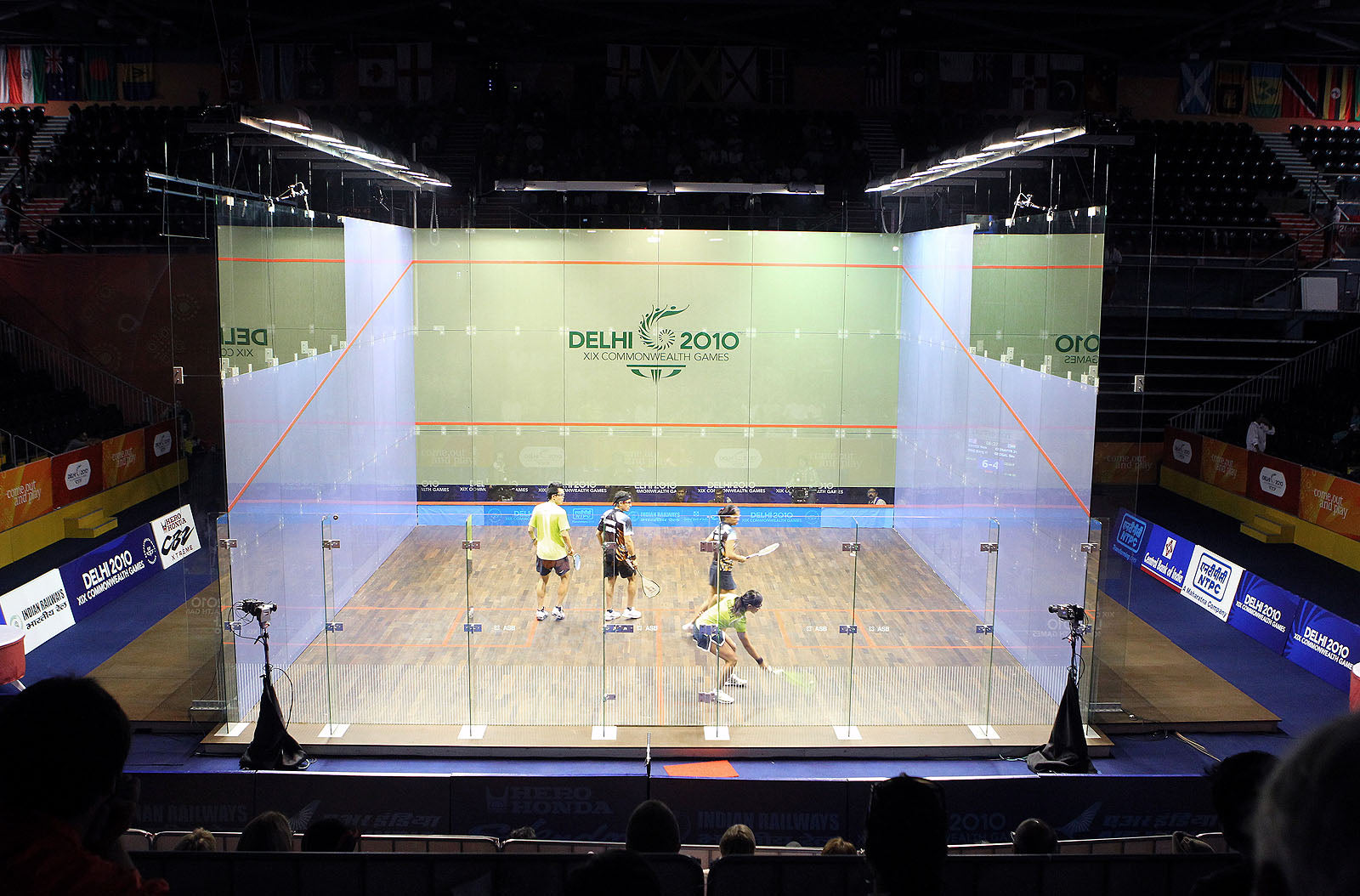
A prototype ASB glass court with doors on the sidewalls – rather than on the back wall, to increase visibility for spectators – was shipped over from Egypt. The location was spectacular. The court was erected on the piazza overlooking Hong Kong harbour with boats sailing by behind the front wall.
But it rained heavily – and play on one day that the IOC bigwigs were there had to be hurriedly transferred indoors to the Hong Kong Squash Centre.
Andrew Shelley, then WSF chief executive, remembers: “We had everything prepared so perfectly, but you can never guarantee the weather! All you can do is show that you can manage the situation. We showed the versatility of the sport and the IOC report was very positive.”
As part of squash’s extensive marketing campaign, Nicol David conducted numerous media interviews and came up with her famous emotive line: “I would trade my six world titles for one Olympic medal.” The IOC’s meeting in Buenos Aires was where the decision on Tokyo 2020 would be made. Vero had helped prepare a slick bid which won wide praise. The IOC had committed to remove a sport to make way for a new one to join the programme. Wrestling was the sport removed. We had a chance.
The three sports which went to the vote in Argentina were squash, baseball and wrestling (which was bidding for immediate reinsertion). The IOC had stated they wanted a ‘new’ sport. Squash was the only ‘new’ sport of the three, and yet the vote went to… wrestling.
Shelley remembers arriving two days early and being couped up in a hotel room rehearsing meticulously, setting up the technical wizardry and preparing for all potential questions.
WSF’s top brass sat alongside Ramy Ashour, Sarah Fitz-Gerald, a 17-year- old Diego Elias (whatever happened to him!?) and Andreina Benedith (an urban squash graduate who grew up in the Bronx). When the decision was announced, the wrestling fraternity (which bizarrely featured the Hollywood actor Billy Baldwin) sitting in the row behind them, celebrated wildly.
Fitz-Gerald remembers: “They all jumped up and started hugging each other. A couple of us – me included – got belted across the back of the head, but they were oblivious. That added injury to insult! I find it quite funny now, but I certainly didn’t at the time.”
Shelley adds: “You look at each other and you just try to avoid kicking any chairs on the way out. You just have to get on with your life and know there’s a cycle for the next Games.”
But Fitz-Gerald felt extremely disillusioned. “We were just completely deflated,” she said. “We knew we had ticked all the boxes. It was a massive, massive kick in the guts. After our presentation, we had watched wrestling’s through a crack in the door. Ours was far better. Wethoughtwewererightinthere. Afterwards, we knew that they had basically misled us. They were always going to put wrestling back in.
“I came away with the opinion that we had to stop spending money on the Olympics. I thought we should focus on participation, make the World Championships a really great event and promote the crap out of the players so people start to understand how amazing they are as athletes, rather than spending thousands of pounds wining and dining people who have already made their decision.”


2024 – Paris
Fitz-Gerald’s feeling of exasperation was shared by many in squash over the next Olympic cycle. After the huge expense of the Tokyo bid, the whole rigmarole was scaled down in the run-up to the Paris decision, with fewer expensive trips and presentations.
That didn’t dispel the familiar sense of fury and injustice when (spoiler alert) the door was once again shut in our faces.
The WSF felt they had an edge because its then president, Jacques Fontaine, was on the French Olympic Committee. The PSA, with its growing media and marketing expertise, was also fully included in the bidding process for the first time. With Lincou, Gregory Gaultier, Camille Serme and a then-teenage Victor Crouin, France was able to show off its squash pedigree.
Comms and PR firm Weber Shandwick were hired to lead the bid, but it was clear early on that squash was not a word on the lips of many in the corridors of power.
The drive for youth engagement – which had started with the additions of skateboarding, surfing, sport climbing and 3v3 basketball in Tokyo – continued with the addition of breakdancing to the Paris roster.
‘Faster, higher, stronger’ seemed to have been replaced by ‘younger, cooler, more YouTube clicks.’ The IOC appeared to have steamrollered over its own criteria for selecting new sports. The goalposts, once more, had shifted.
After our years of earnest and impassioned campaigning, to lose out to what is essentially street kids showing off was a step too far for many in he squash community. Anger boiled over and some even talked about launching legal action against the IOC.
Egypt’s Tarek Momen tweeted: “I’m sorry, but this is the Olympics, not an urban art festival. It’s like saying, ‘Let’s tear down the Mona Lisa and put up some finger paintings to appeal to the children.”
The rhetoric from those at the top of the sport was that the time had finally come to distance ourselves from this costly cycle of rejection and disappointment and focus on protecting and growing our sport and showcasing our athletes independently.
WSF chief Shelley wrote in this magazine at the time: “What does seem to be clear is that until there are signs that the IOC may become more receptive to sports such as ours, we cannot shackle ourselves to the bidding process.”
Looking back now, he is able to pick out positives: “Every failed bid was something that galvanised the sport. It brought us together, reminded us of our strengths and gave us a sense of solidarity.”
That sense of togetherness may have been of some comfort, but the wider picture for squash was bleak. Despite a healthy world tour, grassroots participation continued to decline in virtually every nation and that decline accelerated in the aftermath of the pandemic.
And then, on 15 October 2023, the institution that had inflicted so many wounds made an announcementinMumbaithatfinallychangedthe narrative of squash’s hard luck story.
Come LA28, we will be an Olympic sport.
LATEST NEWS

Gohar: "I love breaking stereotypes"
Motherhood does not appear to have softened the ferocity of Nouran Gohar's ambition. Despite dirty diapers, fractured sleep patterns and doubting voices, her focus is clear: 'I will return to world no.1.'

StayInIt: Graduate League Squash
What happens when the U.S. College experience is over? Step into the world of the Graduate League Squash

Wonderful Woodliffe
Mark Woodliffe's recent World Masters wins set new records, defied repeated medical setbacks and continued an extraordinary family legacy.


