


How squash — and a dash of Cold War theatre — helped Valerii Fedoruk escape one world and start again in another
By Kieran Neller
It’s hard to pinpoint the moment Valerii Fedoruk’s story ceased to be about squash — and became about survival.
Maybe it was when, as a young man in Kolomyia, western Ukraine, he picked up a squash racket almost by accident and discovered not just a sport, but an escape
He didn’t know it then, but squash was going to save him.
Caught somewhere between war and exile — in the uncertain space between a life left behind and one still under construction — it was the squash court that gave Fedoruk his most unlikely form of sanctuary.
In 2021, on a cold weekend in Moscow, he became the first Ukrainian ever to win a PSA World Tour title.
He was 38.
The victory, his proudest moment in squash, came, in a bitter twist of fate, in the very city he would be forced to flee just months later, when Russian tanks crossed the Ukrainian border and turned triumph into trauma.
He hadn’t even meant to end up in squash. At 24, working as a waiter and longing for a way out, he stumbled across an advert on the radio.
“I heard an advertisement that a new fitness club was looking for new staff,” he says. “I couldn’t stand working as a waiter, so I called them. They said there was an opportunity to be a fitness instructor or a squash coach. They offered to teach me squash. I took it.”
The moment he hit the ball for the first time, something shifted.
“I just made a decision straight away. I liked squash. I love playing squash. I want to improve myself,” he says.
“I played the Black Sea Open in 2009. I lost badly. From then, I decided to focus on improving as much as possible.”

Improvement came fast. Fedoruk rose through Eastern European tournaments, coaching others while competing. He became Ukraine’s top-ranked player and eventually received an offer to work as a coach in Moscow — a prospect he welcomed.
“I knew that if I went to Moscow, I could earn some money,” he says. “That money I could invest in myself — travel more, play more.”
Everything was going well. In February 2022, he returned briefly to Ukraine for the national championships. On February 23, he flew back to Moscow.
The next day, war began.
“I didn’t leave Russia immediately because I was scared,” he says. “I was being watched.”
Russia’s internal security service, the FSB, began asking questions. Then they brought him in — four hours of interrogation.
“They asked me about Ukraine, my point of view about the war, how I feel about the situation,” he recalls. “It was a very long conversation.
“I felt they tried to push me. I felt like they tried to talk with me not just as a squash person, but as someone they wanted to use.”
He doesn’t go into detail. But he wasn’t arrested. He was not detained. Just…questioned.
But he was not free, either. “Every day I was waiting for them to arrive and take me away,” he says.
“I was working in Russia, I had a contract but when the war started, I stopped all my relationships with Russia. I had to leave. My family is from Ukraine. My friends. Everyone – they were in Ukraine. There was bombing. There was shooting. I had to do something.”
So he fled — quietly, with only a single bag and some squash rackets over his shoulder. There were no dramatic border crossings under moonlight, but the tension was real.

“I took my bag, I took my squash stuff, and I just left Russia,” he says.
No backdoor escape. No passport panic. Just a slow-motion exit, wrapped in silence and fear.
He crossed the border under the guise of attending a squash tournament in France.
“I bought tickets both ways, just in case I had to prove I was planning to come back,” he says. “At the border they asked me for proof. I convinced them I was going to the tournament like usual.”
The cold precision of his words barely masks the risk, or the sadness. There was no return. No certainty.
“I didn’t know if I could come back. Still, I don’t know if I can go back.”
From there, he became a squash-playing nomad. Barcelona. Warsaw. The World Games in the United States. No fixed address. No promises. Just a life cobbled together one rally at a time.
“I was living just a normal life,” he says, “but thoughts about the war continued. Some of my friends were already killed. I hoped every day to wake up and see it was over."
He sent money back when he could. Played when he could. Waited. He was 40 years old, stateless and alone.
And then squash, improbably, came through again.
His victory in Moscow — the same city he had been forced to flee —had made headlines. Someone in Washington, DC had noticed.
“The owner of Squash On Fire contacted me,” he says. “They said there was an opportunity here if I wanted to try. I was lucky.”
The irony lingers. His victory in Moscow — a symbol of sporting pride — became the unlikely ticket out of exile.
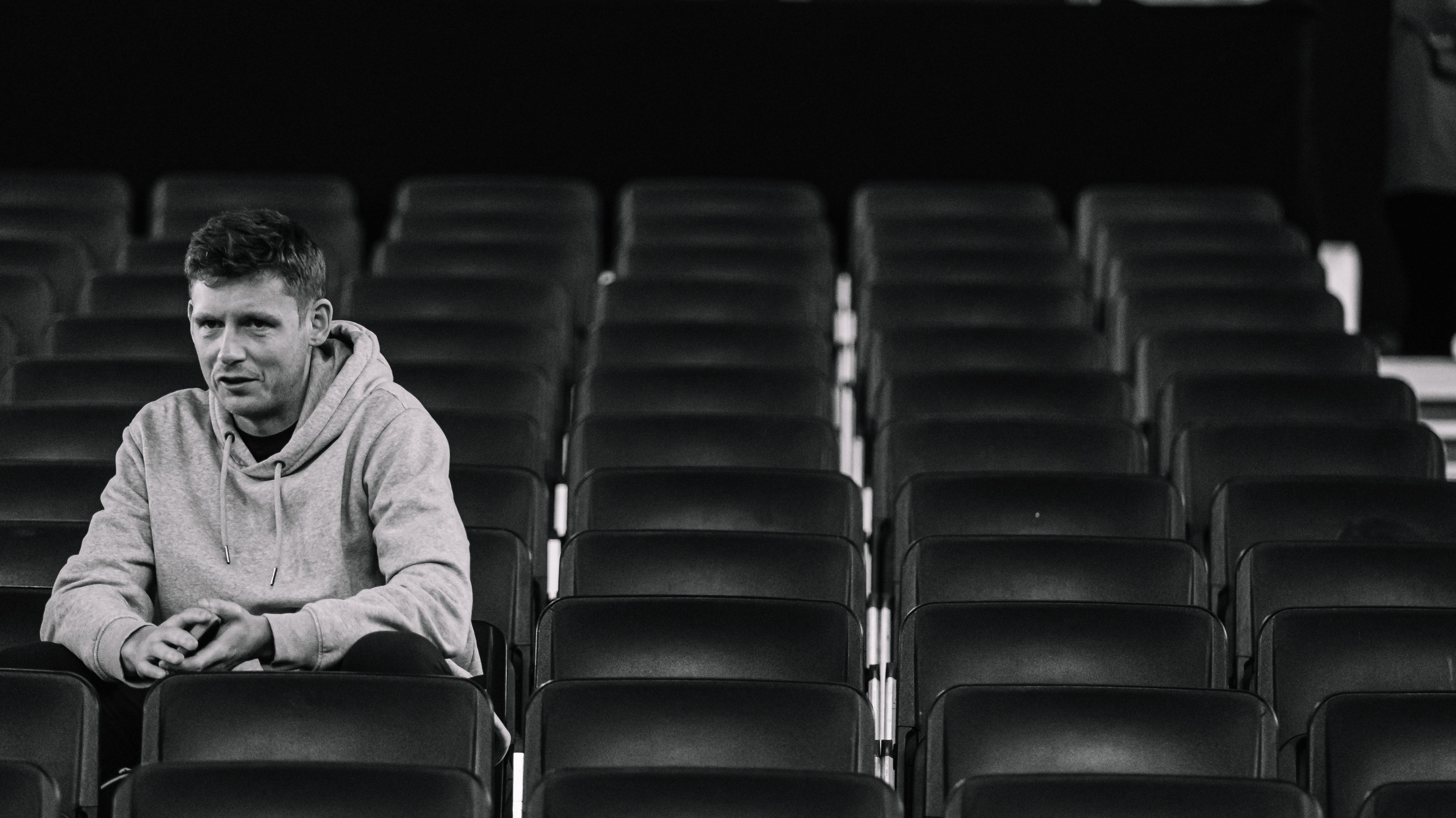
Today, Fedoruk lives and works in DC, coaching at Squash On Fire — a sleek, modern club not far from the White House.
He still plays occasionally on the PSA Tour. Most recently, he was granted a wildcard into the tournament hosted by his own club.
“I am very happy here,” he says. “I have a job. I have family. I am coaching. I am playing.”
There’s nothing grand in that statement. But it carries the quiet weight of a man who knows exactly what he escaped. A year ago, Fedoruk was navigating visas in a foreign country after escaping a war zone. Now, he’s building a new life in the capital city of a country trying to broker peace.
He’s not the only Ukrainian athlete to have sought new ground in the last two years. But squash, perhaps more than most sports, makes you feel the transience. There’s no big money. No agents sorting your life out. You have to make your own way.
It was squash, after all, that took him to Moscow. It was squash that gave him the international credentials to build a new life abroad. And it’s squash that has carried him back — emotionally if not physically — to Ukraine.

Last year, Fedoruk returned to international squash in a different capacity — representing Ukraine at the European Team Championships. This year, he travelled to Poland as head coach of the Ukrainian women’s team.
“2024 was my first time representing Ukraine after the war started,” he says. “It was very emotional. You understand how many things changed in your life.”
He adds: “This year, I travelled as head coach. I’m still active — as a player, coach, supporter. I’m just on hand, ready to help anyone who needs or wants it.”
He says it simply. No need for flourish. He knows what it means to show up — and how much showing up can mean to others.
Ukraine isn’t a squash powerhouse. The sport exists in isolated clubs, often without infrastructure or funding. The war has only deepened the cracks. Some players have fled. Some courts have closed. But Fedoruk, in his way, is still there.
Still playing. Still coaching. Still representing.
And while the squash court in Moscow once made him a champion, it is the court in Washington that made him whole again and it is on the court in Washington, where he talks about his students, about how he still trains once or twice a day, how he’s managing a few injuries, how he just wants to keep going — not because he still thinks he’s going to make it big, but because he still loves the work.
That, in the end, might be the most compelling thing about him. There’s no bitterness. No anger. Just an understated pride that he found a way through — and now gets to help others do the same.
“There are lots of people and countries who keep showing support for Ukraine, and I hope for peace,” he says. “That is all.”
He doesn’t say much more than that. But then, he doesn’t really have to.