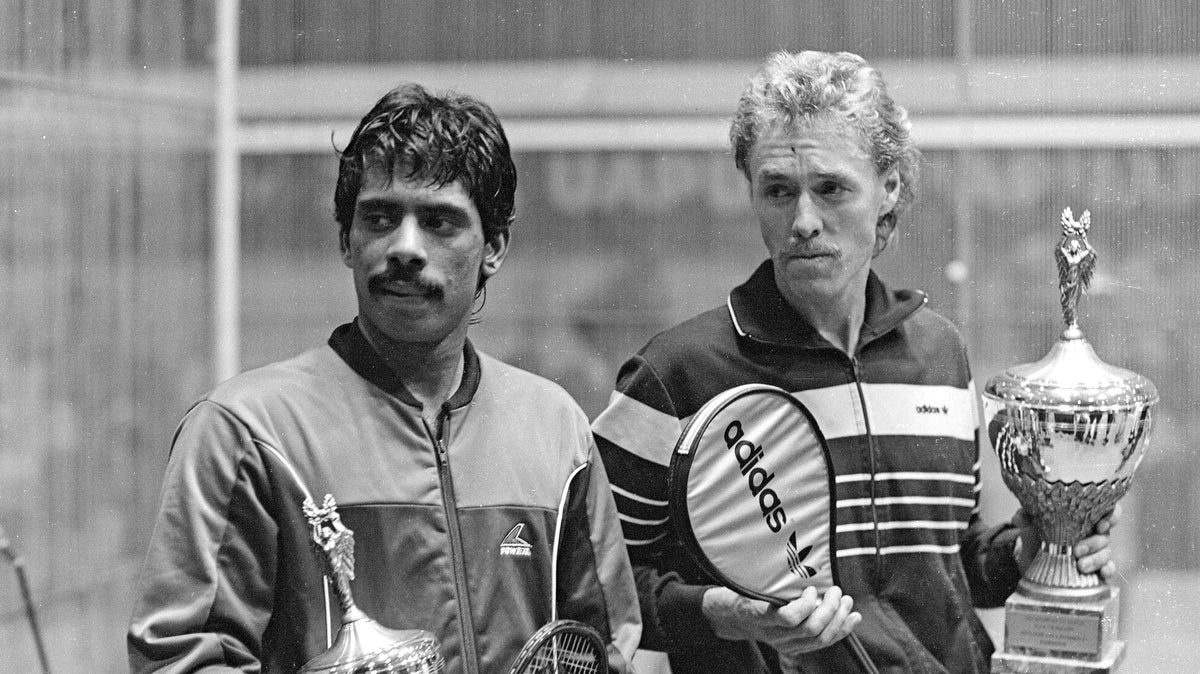
At 6-1 in the fourth game of the 1986 World Open final, Ross Norman gave himself the simplest instruction in sport.
"I thought, 'Do not change your game,'" he says. "'Just carry on playing the way you're going. Don't change a winning game.' And I just, point by point, got it."

Forty years ago today, on 11 November 1986, in the final of the World Open in Toulouse, Norman beat Jahangir Khan 9-5, 9-7, 7-9, 9-1.
It was the first match Jahangir had lost in five years and eight months, the end of a run Guinness World Records lists as the longest unbeaten streak in professional sport - the almost mythical 555.
It is hard now to convey how certain a Jahangir win felt. Some of the journalists in Toulouse had already written their match reports before the final, leaving gaps for the scores. In its report that December, this magazine teased the British writers who had told their readers Khan would win "just as night follows day".
Norman, the world number two, knew that certainty better than anyone. He met Jahangir around 30 times in his career and won only once!
"At his peak, he was just head and shoulders above the rest of us," he says. "To get a game off him created media headlines, never mind trying to win the match."
But in the 1985 World Open final in Cairo, which he lost 3-1, Norman thought he glimpsed something.
"I saw a part of his game which was a little bit vulnerable," he says. He had already made a promise that has followed him ever since: "One day Jahangir will be slightly off his game, and I will get him."
He did not arrive in Toulouse in good form, and the night before the final he played a brutal semi-final against Australia's Chris Robertson. It lasted 1 hour and 40 minutes and left him with a cut forehead: "I didn't hold high hopes," he admits.
The final was fierce from the start. Norman won the first game 9-5. In the second, a run of refereeing decisions turned 3-2 up into 3-5 down, and Norman walked off court to protest. When he went back on and asked Jahangir whether he wanted to change the referee, Khan replied: "It's the same for both of us, so why change?"
Norman took the second 9-7 after more than 41 minutes. Jahangir won the third 9-7. Then, unthinkably, the great man began to tire.
"I didn't realise that he was getting tired," Norman says. "He didn't show it. But certainly in the fourth game, he seemed quite tired." The fourth lasted under ten minutes. At 8-1, Norman hit a cross-court drive that Jahangir lunged at and missed.
"It's one of those very, very few moments in your life," Norman says, "that you will remember very clearly for the rest of your life."

There was no time for a shower, only interviews.
When Norman finally rang his parents in New Zealand, they already knew. They had been listening on the radio.
The headlines that followed were mostly about the man he had beaten. "The publicity was more about Jahangir getting beaten than me actually winning," Norman says. "And by the way, it was me that beat him, sort of thing. A tag on the end."

Jahangir, he believes, felt both shock and relief. "Every time he stepped on court, he was expected to win."
The defeat barely slowed Jahangir. He didn't lose again until October 1987. Even the famous figure of 555 matches, he says now, undersells it. "There was more than 600 to 700 matches, which I never calculated," Jahangir says. "The number doesn't make any difference." What matters to him is simpler: "In six and a half years altogether, I lost only one match."
Forty years on, that one match still belongs to Ross Norman.
Read the full story of Toulouse 1986, with Squash Player's original match report, Steve Line's photographs and both men looking back, in the December issue