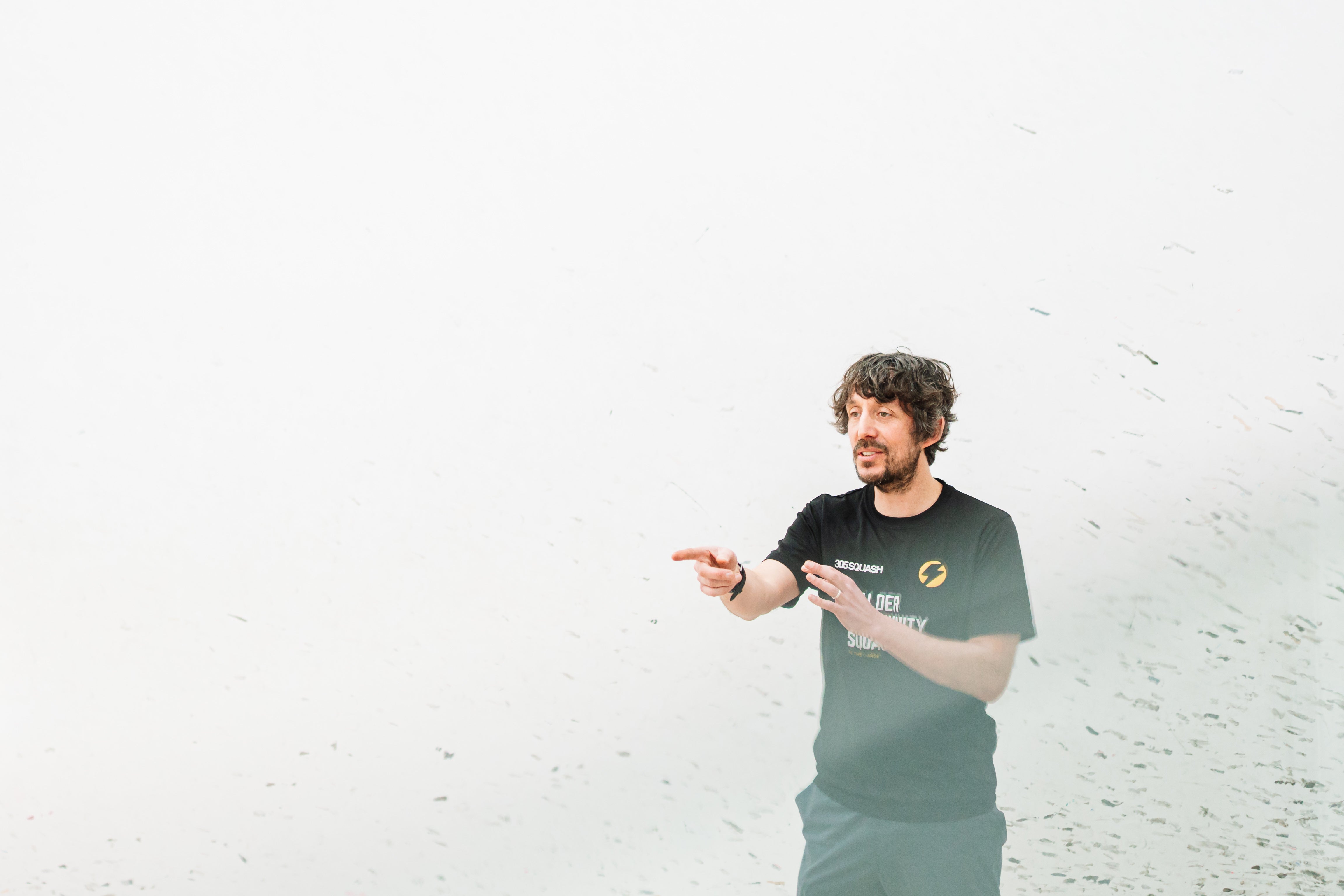




Nick Johannessen arrived with no expectations.
He had been homeless. He had struggled with addiction. He had, for the longest time, been at war with himself. The idea that a squash court might offer him something more than just a game was absurd.
Yet, here he is. 10am on a Saturday morning, coaching the game to local children - passing on knowledge, making a difference to his community.
“Life is strange sometimes,” he says. “You think it’ll go one way, but reality is totally different. A lot of times, you’re just not where you want to be.”
He says this without bitterness. As if, somehow, he always knew there might be a way out, even if he couldn’t quite see it at the time.
Johannessen’s introduction to squash was, like many turning points in life, almost accidental. He was attending a mental health recovery programme in Halifax when he heard about BounceBack, a community squash initiative aimed at people like him—people in recovery, from homelessness, addiction, or simply the weight of a life that had spiralled.
It was a groundbreaking initiative by Calder Community Squash, an organisation determined to break down the barriers to participation and accessibility that have long surrounded the game.
Based in Halifax, Calder Community Squash is pioneering efforts to make squash accessible to people who would never usually pick up a racket. Two of its flagship programmes - BounceBack - and Squash from the Mosque, an initiative engaging Muslim communities in the sport—are the first of their kind in the UK.
For Johannessen, Calder Community Squash didn’t just introduce him to squash—it changed the course of his life.

“I thought, why not?,” says Nick. “I was trying to do more for my mental health, trying to get fit.
“I’d been going to the gym, doing CrossFit. But squash? I didn’t know much about it, except that my dad used to play. Typical 90s bloke, sweatbands, big mobile phone. That was squash to me.”
He went. He played. He kept coming back.
“It just clicked,” he says. “I came one time and fell in love with it. It’s helped me massively—my mental health, my fitness, even staying clean. It’s put a bit of structure into my life.”
The word structure lingers. For someone who had spent years on the edge of survival, trapped in the unpredictability of addiction and homelessness, structure was a revelation.
Johannessen pauses, considering.
That first session could have been his last. He had almost talked himself out of it.
“To be honest, at first, I felt out of place,” he admits. “I thought, ‘I’m not fit enough for this, I don’t belong here.’ Squash was always something I associated with posh clubs and people who had their lives together.
“That wasn’t me.”
But Calder Community Squash is built on the idea that squash should be for everyone, not just the privileged few.
“They said, ‘It’s not about being the best, it’s about showing up.’ That stuck with me.”
And so he kept showing up. He learned to anticipate the ball, to trust his body, to relish the fight for each point. But more than that, he learned to belong.
“The community aspect, that’s what made it different,” he says. “You’re stepping out of your comfort zone, meeting people from different backgrounds, different religions, different experiences. You start realising you’re not as alone as you thought.
“It wasn’t really about the squash, not at first. It was about having a space where you could feel safe. It was almost like therapy—physical therapy with the exercise, but also a mental and emotional release afterwards when we would sit around and talk.”
At some point, something shifted. He wasn’t just attending anymore. He was involved.
“They asked if I wanted to do a bit of voluntary work, and I thought, yeah, why not? At first, I helped out with the BounceBack sessions, and then I started doing some coaching for the Squash From The Mosque programme.
“That led to junior sessions. And then, all of a sudden, I had a part-time paid role coaching.”

If you had asked him a few years ago if he saw himself as a coach, a mentor, a figure of inspiration - he would have laughed.
“A couple of years ago, I never imagined I’d be in the position I am today,” he says. “I’ve always suffered from anxiety, but now I can speak publicly. I have confidence.”
Confidence. That thing he thought he’d never find.
Now, every Saturday, Johannessen is the one creating that space for others as part of the Calder Community Squash team, rewriting the narrative of who plays squash in the UK.
The club’s Squash from the Mosque programme is a first-of-its-kind initiative, designed to introduce Muslim communities—especially children—to the sport in a culturally inclusive way.
“It’s a brilliant programme,” Johannessen says. “It’s about making squash welcoming for communities that might not have seen themselves in the sport before.
“I helped run sessions for kids who had never even heard of squash, and now they love it.
“Saturday mornings are packed. We start with fun games—dodgeball, soft squash—then gradually introduce them to proper squash. After that, we have a session for older kids, where we work on skills, box leagues, and match play.
“It’s great to see them grow their skills and in confidence, just like I did.
“People think you have to be super fit or have loads of money to play,” Johannessen adds. “But that’s not true. That’s what we’re trying to change.”
This journey has taken him further than he ever thought possible - and not just on the court.
For Nick now works in the homeless sector, helping people where he was just a few years ago get off the streets, into emergency accommodation, and eventually, independent living.
“Now I’m on the other side,” he says. “Helping people in the same situation I was in. We find rough sleepers, get them into housing, set them up with benefits, GPs, bank accounts—everything they need to rebuild.
“It’s surreal, because I know I could have easily still been there. But now I’m helping people find their way out.”
And sometimes, those people find their way onto a squash court.
“There’ve been a few who came through BounceBack after I met them on the streets,” he says. “It’s incredible to see that full-circle moment—seeing someone who was sleeping rough a few months ago now standing on a squash court, laughing, playing, feeling like they belong.
“That’s what it’s all about.”

Nick Johannessen’s story is not just one of recovery. It is a testament to the power of sport, of community, and of a squash programme that dared to do things differently.
“At one point, I didn’t have my family there because of how chaotic I was living,” he admits. “Now, I’ve got my family back, and it makes me proud that I can make them proud, too.
Pride. Another thing he thought he’d lost forever.
“I’m proud to get up in the morning now. I have purpose. And I feel capable—I feel like I can offer something to someone. That makes me happy.”
He pauses, then smiles.
“All it took was that first step,” he says. “And here I am now—working, teaching squash, and finding joy in it all.”
Had Calder Community Squash not launched BounceBack, would he ever have stepped onto a court? Had the club not challenged the sport’s exclusivity, would he have stayed?
For Nick went searching for a way out of the darkness and found, in the unexpected embrace of a squash club, not just a game—but a lifeline.