First published in Squash Player 26.2
On a balmy evening in May 1996, beneath the oldest monument humanity has ever built, squash tilted on its axis.
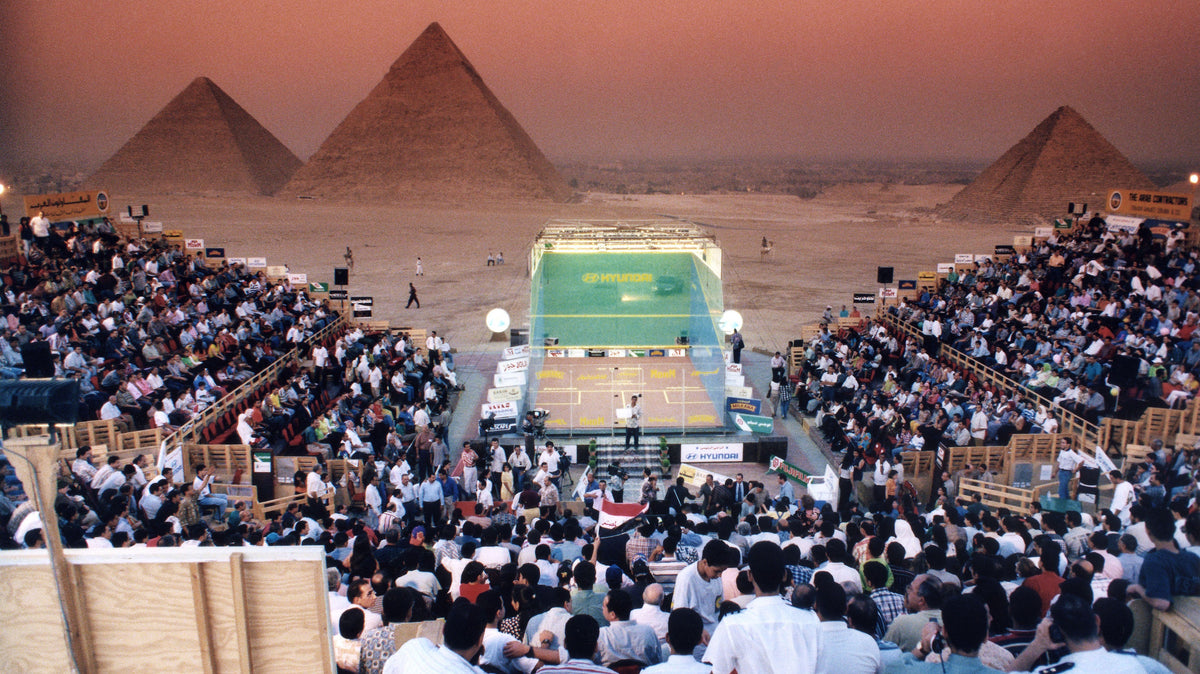
The first Al-Ahram International tournament had arrived at the Pyramids of Giza with all the ambition of a nation trying to announce itself to the world. A glass court stood improbably in the desert, floodlit against the limestone silhouettes of Khufu and Khafre, as though modern sport had wandered into antiquity by mistake.
 (Photo: Steve Line)
The court shimmered in the dusk. Television cameras circled. The air carried that peculiar Cairo electricity: heat, traffic, anticipation.
And then came Ahmed Barada. Unseeded. Unburdened. Unfolding.
At the time, Egypt still existed on the edges of squash’s global hierarchy: respected historically, but not feared contemporarily. The sport’s centre of gravity belonged elsewhere. England. Pakistan. Australia.
The old imperial and Commonwealth powers that had controlled squash’s great titles for decades. Egypt had heritage, certainly. But heritage is not the same thing as supremacy.
Barada was just 19. A recently crowned world junior champion, he was a promising talent, but not yet a player expected to challenge for major titles. Yet over the course of that week in Cairo he became something larger than a player.
He became visible - catapulted into the homes and consciousness of every living Egyptian at the time, setting Egyptian squash on an improbable trajectory.
His run that week itself felt almost cinematic.
Victories over World no.2 Rodney Eyles and no.6 seed Chris Walker saw Barada book a place in the final against Jansher Khan - the game’s unquestioned champion of the time.
Egyptian crowds packed around the court, seeing in Barada not merely a talented athlete but the outline of something national. Here was an Egyptian not just participating in a traditionally Anglo-dominated sport, but thrilling within it, improvising within it, carrying himself with swagger beneath the pyramids themselves.
It mattered where this was happening.
The Al-Ahram tournament was more than an event. It was theatre. Branding. Aspiration. Egypt placing squash against the backdrop of one of the Seven Wonders of the Ancient World and effectively telling the sport: this belongs here too.

Barada in full flow
But Barada’s rise was not powered by sporting talent alone. It came at the junction of three unusually potent forces: celebrity, media and state attention.
At the top sat Hosni Mubarak, Egypt’s president, a keen squash player and admirer of Barada. In most countries squash had to beg for visibility; in Egypt, for a time, it had the quiet blessing of the most powerful man in the state.
Mubarak’s enthusiasm did not create the Egyptian squash boom, but it gave the sport prestige, access and permission to imagine itself as something bigger than a club pursuit.
"When you ask about was he very helpful for squash? Absolutely," says Khaled Sobhy, father of current professional Amanda and a regular playing partner of Mubarak during his presidency.
"When everyone knows that he plays squash, everyone starts to go support squash when we have tournaments. It helped everyone to go out of their shell and then step up and do something big for the squash."
This mattered. Squash in Egypt was no longer simply a pastime for private clubs. It had become a sport capable of attracting political attention, television coverage and national pride. Barada was not merely a brilliant young player; he became a symbol of what Egyptian excellence could look like when given a stage.
And that stage was built, crucially, by the media.
 (Ibrahim Hegazy with women's Al Ahram winner Michelle Martin in 1998)
The Al-Ahram International was not simply a tournament with a spectacular venue. It was created and amplified by one of Egypt’s great media institutions. Al-Ahram, the country’s most influential newspaper establishment, gave the event not only sponsorship but cultural weight.
It understood something squash had often failed to understand about itself: elite sport needs mythology as much as competition.
The Pyramids were the mythology. Barada was the protagonist. Al-Ahram was the megaphone.
At the centre of that media push stood Ibrahim Hegazy, one of Egypt’s most influential sports journalists and editor-in-chief of Al-Ahram’s sporting coverage.
His role gives the story an almost novelistic symmetry. Hegazi was not only helping to promote the tournament that would make Barada a national figure; his daughter, May Hegazy, had been part of the fragile first wave of Egyptian women’s squash.
Three years earlier, in 1993, Dr Samiha El Magd had taken May Hegazy, Salma Shabana and Maha Zein to the World Junior Championships - a tiny delegation that would later be remembered as one of the foundational moments in the rise of Egyptian women’s squash.
So, in the Al-Ahram story, the threads converge: presidential patronage, newspaper power, family investment, sporting ambition. Egypt’s squash revolution was not born in one place. It was built across courts, clubs, television screens, newspaper pages and family homes. 
For Steve Line, the photographer whose images of the Pyramids court became among the sport’s most famous, the event’s promotional force was immediate. Al-Ahram, he recalls, “wanted to get as much publicity for themselves in the sport and for Barada as possible”, sending images through agencies to newspapers across the world.
“Egypt would have received enormous, absolutely enormous international publicity from it,” he says.
Omar El Borolossy would later describe the Al- Ahram Open as “the biggest and the best squash promotion that was ever done”.
But the true legacy of that first tournament was not visual. It was psychological.
Because for the first time, a generation of young Egyptians could look at squash and see not an inherited colonial curiosity, nor an elite club sport hidden behind closed doors, but a pathway.
Two years earlier, Barada had already cracked something open. In 1994 he became the first Egyptian ever to win the World Junior Championship.
That same year, Egypt’s boys’ team won the World Junior Team Championship for the first time.
Those victories now feel less like isolated successes than the first tremors of a sporting earthquake.
The team itself would become foundational mythology in Egyptian squash: Barada, Borolossy, Amir Wagih and a gifted young teenager named Amr Shabana.
Five years later, much of that same generation would make history again, becoming the first Egyptian team to win the senior World Team Championship in Cairo. Symbolically, beating Australia and Wales, two of the old centres of squash tradition.
The old order had not merely been challenged; it had been overtaken.

The squash historian James Zug believes the significance of the moment extended far beyond one tournament.
“Egypt always had great players and great tradition,” he says.
“But at the Pyramids in 1996, there’s 5,000 people there watching. It’s a great moment for Egyptian sport, and one that enables squash to become a central highlight for the nation.
“In the 1990s we also had globalisation. The world was opening up.”
Suddenly, squash in Egypt was no longer hidden inside clubs. It was visible. Aspirational. National.
“It needed that spark,” Zug says. “In ’96 the event is broadcast live on TV. Mubarak drives up in a limousine, it’s all over the newspapers, it’s on the radio, it’s all over TV. In literally one match people just went nuts about squash.”
 (The 1999 Men's World Teams Champions)
There is a temptation, with the benefit of hindsight, to view the 1996 Al-Ahram International as the singular ignition point of Egypt’s squash dominance and Ahmed Barada as the lone revolutionary who dragged the sport into the Egyptian mainstream.
But Andrew Shelley, a long-time squash administrator, is careful to dismantle that simplification.
“The Al-Ahram event really came before Barada,” he explains.
“Barada had already won the World Junior title in 1994, but he was not yet the established force history sometimes retroactively paints him as.
“Squash had been in the Egyptian psyche before. The Pyramids event did not create Egyptian squash from nothing. Rather, it illuminated something that had already been quietly growing for years.”
What Barada did was give that system a superstar and the Al-Ahram International gave it a stage worthy of him.
In Cairo, backed by a fervent home crowd whose rhythmic clapping echoed into the desert night, Barada became magnetic. The convergence of player, place and moment proved transformative.
The event elevated Barada, but Barada also elevated the event, turning a bold promotional gamble into something mythological.
Together, they changed not only how Egypt viewed squash, but how squash viewed itself.
 Tarek Momen, the 2019 world champion, remembers the effect almost viscerally.
“Going to the events and watching Barada in the 1990s was a big thing for us junior players of the time,” he says. “We begged our parents to take us.”
Momen’s generation did not simply admire Barada. They absorbed him.
“Barada was famous. He was the first Egyptian player in decades to get to the top of the game. His success showed what was possible and inspired an obsession with the game for a generation of kids.”
Raneem El Welily, who in 2016 became the first Egyptian female in any sport to become World no.1, remembers the same phenomenon from a different perspective.
“When I was seven, I used to go with my family to Cairo to watch Barada at the Pyramids,” she says.
“That tournament put Egypt on the map and inspired us to want to become like Barada and have that experience of playing in front of the Pyramids and having success for Egypt.
“Even today everyone in Egypt knows who Barada is. He was a huge star.”
Four-time World Champion Ali Farag was another one of those children in the stands.
“My dad was a big fan and he used to take me and my brother to go and watch,” he says.
“It was not a short drive, to be fair, but this is how fascinating it was. At the time there were only maybe 10 channels on TV and Barada would always be on it. This is how popular he was.”
Even now, Farag says, Barada’s name retains an almost folk-memory quality in Egypt.
“Until this very day, like 25 years or 20 years after he’d retired already, if you go anywhere and you say you play squash, people would ask you: like Ahmad Barada? This is how popular he was and he still is. This is how it all kick-started in Egypt really.”

(Barada celebrates winning in 1998)
Thirty years later, the sport still lives in the shadow of that week.
The irony at the heart of Egyptian squash is impossible to ignore. Like so many institutions woven into Egyptian life, the game arrived through empire.
British officers brought squash into Egypt during the colonial era in the early 20th century. Courts appeared inside expatriate clubs, military spaces and upper-class institutions. The Egyptian Squash Federation was founded in 1931, making it one of the oldest squash federations in the world.
And from the beginning Egypt proved unusually adept at the sport.
Players such as F. D. Amr Bey in the 1930s, Mahmoud Karim in the 1940s and Abdel Fattah AbouTaleb in the 1960s established Egypt as a serious squash nation long before the modern boom. Amr Bey became the game’s first truly dominant figure, winning the British Open - effectively the world championship of its time - six consecutive times between 1932 and 1937.
But those successes existed within a fragmented sporting landscape. Squash remained small, elite and socially narrow. It was respected, but peripheral.
Then came the turbulence of the 1950s. The Egyptian Revolution of 1952 transformed the country politically and culturally. British influence receded. National identity hardened. Priorities shifted.
Squash did not disappear. But it became quieter.
Meanwhile, in Britain, Australia and particularly Pakistan, the sport exploded competitively. Pakistan developed an almost mystical relationship with squash through the Khan dynasty, producing champions with such relentlessness that domination came to feel hereditary.
Egypt watched from a distance. And yet, in hindsight, this dormant period may have been essential. Because while squash declined commercially in some traditional nations during the late 20th century, Egypt retained something valuable: density.

(Momen v Farag in the 2018 World Championship final)
The clubs survived. The courts remained. The social culture endured and when the conditions became right again, the country was ready. To understand Barada’s importance, you have to understand the Egypt of the 1990s.
This was a country opening itself culturally and economically after decades of relative insularity.
Satellite television was expanding. Celebrity culture was emerging. Sporting success carried symbolic power.
And Barada did not look or behave like the squash players the world was accustomed to.
He carried himself like a footballer. He had charisma. Celebrity appeal. He appeared in magazines, television programmes and advertisements. He became famous beyond squash. More importantly, he made squash aspirational.
Paul Johnson, who played Barada in that era, remembers the transformation as “overnight stardom”. After Al-Ahram, he says, Barada became not merely a star but “a megastar”. There were television shows, radio shows, film roles, songs, children waiting in lines for autographs, families trying to take pictures.
“All of a sudden,” Johnson says, “he became this kind of icon in Egypt.”
Children who had never considered the game suddenly wanted to play. Parents who previously viewed it as niche or inaccessible began to see possibility.
The Al-Ahram tournament amplified all of it. For Egyptian players, it altered the scale of imagination. Suddenly the world’s best were coming to Cairo. Suddenly Egyptians were not merely competing with them; they were becoming them.
The atmosphere itself became part of the legend.
Line remembers the 1998 final as “like being in the middle of a highly charged, very important football game”. Coach-loads of supporters were brought to the desert. Football-style chant leaders whipped up the stands. Barada fed off the emotion.
“I’ve never come across an atmosphere like that ever since,” Line says. “You felt squash had arrived internationally.”
Johnson’s memory of playing Barada at Al-Ahram is even more visceral.
“They used to bring fans from Cairo out to the stadium,” he says. “Two and a half thousand, three thousand spectators came to sit and watch Barada play.”
And once the breakthrough came, it accelerated with astonishing speed.
Since Barada’s triumph in 1994, Egypt’s boys’ teams have appeared in every World Junior Team Championship final bar one, winning seven titles.
The individual dominance became even more extraordinary.
Of the 22 World Junior boys’ titles contested after Barada’s breakthrough, Egyptians won 15. Ahmed Faizy. Karim Darwish. Shabana. Ramy Ashour, Mohamed ElShorbagy, Marwan ElShorbagy, Mostafa Asal and Mohamed Zakaria all winning twice, with Amr Khaled Khalifa, Karim El Hammamy and Marwan Tarek also taking that title.
What had begun as a breakthrough was becoming a system.

(Current World No.1 Mostafa Asal in action)
Farag remembers growing up inside the machine Egypt was becoming.
“I grew up in one of the prominent clubs playing in the same team with Ramy Ashour, Hisham Ashour, Omar Mosaad, Muhammad Ali Reda, my elder brother Wael, Yasser El Halaby,” he says.
“Because of that, we had the best set of coaches, whether squash coaches or physical trainers.”
This is perhaps the single greatest misunderstanding outsiders have about Egyptian squash. They search for a secret but Egypt’s dominance is not built on secrecy. It is built on saturation.
Everything feeds everything else.
The players train together. The competition is relentless. The volume is difficult for outsiders to fully comprehend.
Farag sees Barada not simply as a symbol, but as the human first domino. “We all aspire to become top players like Ahmad Barada and play on such an inspirational stage in front of the Pyramids,” he says.
“So we picked up the racket and there were so many of us that started playing. And then by statistical probabilities, you would have more talents coming out of it. We’ve started becoming the nation we are because of Ahmad Barada.”
Respected Egyptian coach Ashraf Hanafi believes this density is one of the defining features of Egyptian squash.
“People ask what the secret to Egyptian success is - and there are many parts,” he says.
“We have a raw, natural talent for the game. Like Brazilians are naturally gifted at football, Egyptians are naturally gifted at squash.
“We have many competitions locally and many players competing in all the age groups. An under-11 draw can often have 256 players, with a qualifying draw before that. In some other countries, they would be happy to have 16 players.”
Momen experienced that ecosystem from childhood.
“When I was nine or 10, I would already be playing 12 tournaments a year,” he says. “Competing so often helps juniors mature.
“You get ahead of young players from other countries because the competition is at such a high level consistently.”
Farag sees the same advantage.
“One of the best things about Egypt is the many tournaments we’ve got and the very big draws every other weekend,” he says.
“There are so many things that you can’t learn in practice, only from experience in matches.”
Elite performance is rarely individual. It is environmental.
A talented 10-year-old in Cairo may train beside a world champion, lose repeatedly to older juniors, play meaningful matches every weekend and absorb elite habits almost by osmosis.
Farag describes one of Egypt’s great advantages in wonderfully ordinary terms.
“The furthest you have to drive to watch or play with any of these guys is like 45 minutes.”
That proximity matters. Greatness becomes normal. And once greatness becomes normal, ambition changes shape.
Farag remembers one childhood encounter with Barada at Heliopolis. Barada was practising. A seven-year-old Farag hovered nearby, trying simply to make eye contact.
Barada noticed him. “How are you? What’s your name?” he asked. Farag told him. “Do you drink your milk every day?” Barada replied.
“I wanted to be strong. I went back home and told the story to all my friends, my family, my parents. Ahmad Barada has spoken to me. I couldn’t believe it.”

(Mohamed Zakaria, the most recent Egyptian World Junior champion)
There is another element too: the Egyptian style itself.
If Egypt created the deepest competitive ecosystem in squash, it also reshaped the aesthetics of the sport.
Traditional orthodoxy had long emphasised patience, structure and attrition. Build pressure to the back. Wait for openings. Minimise risk.
The Egyptians disrupted that logic.
“From the start, we changed the game,” Hanafi says.
“The British played mainly to the back of the court and waited for opportunities to attack.
“Egyptians play in the front half of the court. We move the opponent more. We attack straight away and play at a higher pace.”
He traces much of that transformation back to Shabana - one of Barada’s contemporaries and the first Egyptian man to win the coveted World Championship.
Players such as Ashour turned squash into something almost artistic - all flickering wrists and impossible angles - while others such as Mohamed ElShorbagy and Nouran
Gohar weaponised relentless intensity.
Yet Hanafi describes Shabana almost reverentially.
“He is called the Maestro because he played with so much skill and control and made difficult shots look easy.
“A whole generation followed in his footsteps and wanted to play the game the way he did. From Ramy Ashour to Mohamed ElShorbagy to Ali Farag, these legends began by following Shabana - and then they inspired another generation in turn.”
Borolossy agrees.
“Shabana was an incredible talent and a player who changed the game,” he says. “Then after him came Ashour, another phenomenal talent.
“Those two had the greatest impact on changing the way squash is played.”
The style itself, Borolossy believes, reflects something broader about Egyptian culture.
“The Egyptian personality fits well with a system based on variation,” he says. “We don’t like rigid systems.
“In squash we can create angles, play with many different styles.”
Hanafi offers a more chaotic metaphor.
“It is similar to how we drive,” he laughs. “In most countries, when the light is red you stop, when it is green you go. In Egypt we go when the light is red or green. We make space and think differently.”
That, perhaps, is the closest thing Egyptian squash has to a manifesto.
And it is why the legacy of Al-Ahram cannot be reduced to nostalgia.
The glass court beneath the Pyramids was not simply a beautiful backdrop. It was a point of ignition. It fused together the elements Egypt already possessed - courts, coaches, club culture, junior competition, political interest, media attention and a young player capable of carrying the nation’s imagination - and made them visible.
Three decades later, the scale of Egyptian dominance borders on absurd.
Seven world No.1s. Dozens of world junior titles.
Generations overlapping seamlessly. For long stretches of the past decade, half the world’s top 10 have been Egyptian. The old squash powers - England, Australia, Pakistan - have not disappeared, but they have been forced to orbit a new centre.
Competition begins young. The pathway narrows quickly. In a nation where success has become normalised, failure becomes psychologically complicated.
Young Egyptians no longer dream vaguely of becoming professionals. They assume it is achievable.
Current women’s world no.1 Hania El Hammamy believes that mentality begins early.
“We’ve been brought up in an environment where it is all about competition,” she says. “It builds something inside us that develops champions.
“Then having legends in our country leading and showing us the way is a huge influence.”
Farag describes Barada’s influence as a “snowball effect”.
“Look at my generation,” he says. “Myself, Mohammed, Karim Abdel Gawad, Fares, Mazen, Marwan - all of this generation, we started because of what was happening at the Pyramids.
“And then all of us have made it to top 10. If it wasn’t for Barada, would we be here today? I doubt it, to be honest.”
That is the true legacy of Al-Ahram.
Not that it created Egyptian squash from nothing. It did not. Egypt did not become a squash superpower because of one tournament, one player or one night in the desert. The courts were already there. The coaches were already there. The hunger was already there.
What Al-Ahram did was give all of it a stage. It made squash visible. It made it glamorous. It made it national.
And from that visibility came imitation; from imitation came density; from density came dominance. That is how sporting cultures are built.
Squash arrived in Egypt through empire. It was introduced by British officers, institutionalised through colonial structures and initially confined to elite circles.
But somewhere along the line, Egypt stopped borrowing the sport and started remaking it. The Al-Ahram International was the night that transformation became visible to the world. And perhaps that is the lesson of Egypt’s dominance.
The greatest sporting cultures are not the ones that preserve games exactly as they inherited them - they are the ones bold enough to transform them.