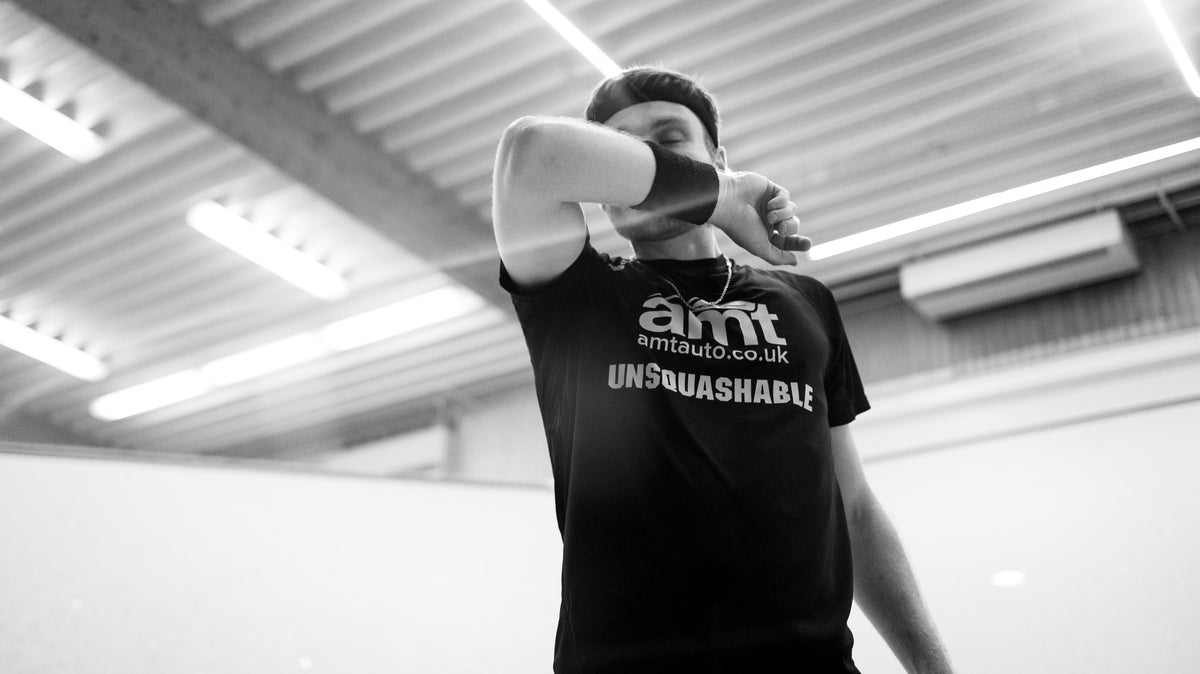
For Will Salter, a training trip to Egypt was supposed to be an opportunity to sharpen his game against some of the world’s best male players. Instead, it was an unexpected match against the women’s World No.1 that left the biggest impression.

Salter, currently ranked World No.135, had spent a couple of weeks in Egypt, taking advantage of the country’s deep pool of elite squash talent and playing matches whenever he could. When a scheduled opponent pulled out, he was determined not to waste the opportunity.
A message offered him an alternative - Amina Orfi was available.
“I’d been in Egypt for a couple of weeks training, playing with guys that I’d made friends with at tournaments. I had a match lined up with a player, but he couldn’t play but I really wanted to have that session in.
"I couldn’t book courts so I was reliant on other players to book courts for me but then Yassin replied to me and said that Amina was available. I only know one Amina so assumed it would be Orfi.”
That assumption turned out to be correct.
Salter made his way to the Gezira Club in Cairo, where he was introduced to a rather unusual aspect of Orfi’s status at the club.
“I got a taxi over to the Gezira Club in Cairo and they escorted me to Amina’s personal court. She’s got a court there where she never has to book. If people are on that court and she turns up, they have to vacate for her to train on it.
"Everyone who plays there knows that is the case but it’s pretty cool to have that.”
At the time, Salter was not particularly intimidated by the prospect of facing the teenager. Conventional assumptions about male and female players in squash had shaped his expectations. He was bigger, he was physically stronger and he was accustomed to competing against men on the PSA Squash Tour.

So he expected to win but he knew it wouldn’t be easy.
“I expected it to be tough, but I thought that I’d probably win anyway,” he said.
“Just from what everyone always tells you, that guys are way better than girls at squash. So, I thought I’d probably end up winning because of the strength aspect; I’m twice the size of her. But I did think it would be tough; I thought it could easily turn into a long match because I knew her length game was so good, but I backed myself to get over the line and have too much physicality for her."
Those expectations did not survive long.
From the first few rallies, Orfi began to impose herself with the very qualities Salter had expected to have in his favour. Her length was relentless, her accuracy exceptional and, perhaps most surprisingly to him, the weight of her shot was proving superior.
“As soon as we started playing and she was just crunching balls down the backhand side I thought, ‘Oh, this might not be as straightforward as I thought’.
"She was hitting the ball consistently more powerfully than I was, way more accurately too.
“It quickly became apparent to me that I was just surviving down that backhand side and chipping the ball back. When she was just getting across and belting it every time, I got trapped. I tried to switch the play over to the other side but she just pumped it back. It just became this horrible length game where I was being pinned in the back left and couldn’t really get out.”

The first game eventually went Salter’s way, but even then, there was little evidence that the contest was following the script he had anticipated.
After around 25 minutes, Salter edged the opener 11-8. Orfi had appeared to fade slightly in the closing rallies, giving the Englishman reason to believe that his physical advantage might finally begin to emerge.
It was a misleading sign.
“I ended up winning the first game 11-8 after about 25 minutes. But she dropped off in the last three rallies, which made me think that the physicality was creeping in now and I was okay. Little did I know, she could do this for a long, long time.
“She had her parents there, a few coaches and now a bit of a crowd of local players. They were all cheering for her and shouting things at her mid-match whilst I was just battling away on my own, desperately trying not to lose to a 19-year-old girl.”
Orfi responded by taking the next two games, leaving Salter facing a familiar dilemma: find a way to counter the relentless length or spend another game attempting to survive it.
He managed to force a fifth.
“I went 2-1 down but then managed to squeeze the fourth to set up a decider. It went point for point in the fifth game, but she just managed to edge it 11-8.”
For Salter, it was not just the result that surprised him, but how the match played out. He had expected his size and strength to give him an advantage, but instead found himself losing the physical battle.
“She was just an absolute battering ram. A beast. Physically, just flawless.”

It was the physical side of the encounter, though, that stayed with him most.
The conventional expectation had been that the size difference would give Salter a natural advantage. Instead, Orfi was the player dictating the pace, controlling the exchanges and producing the heavier, more accurate ball.
“I was just really surprised and impressed with her physicality. Given how young she is and the size difference between the two of us, I was just expecting to dominate the middle, hit into the space and just be too strong in all areas for her, but if anything, it was the opposite.
“Her average weight of shot was better than mine, her accuracy was better, her tactics were better; I was fair and squarely beaten.”
For years, male players have often carried an assumption into informal or training matches against women that their physical advantages will ultimately be enough to get them through.
Salter admits he had done exactly that.
“It’s definitely given me a greater level of respect for both Amina and the top of the women’s game.”
And, crucially, he believes that assumption is far more common than many players would openly acknowledge.
“Everyone always tells you as a male professional that you’re better than all the female players on tour and without playing them, you’d go along with that; I certainly did, and I’d bet that the majority of male squash players on tour think that.
"But until you actually get on court and play them, you don’t know.”
There were, of course, caveats. Salter was not at his freshest after two weeks of intensive matchplay. Orfi had home-court support, while Salter was the outsider on a court surrounded by her coaches, family and supporters.
But none of those factors, he feels, should obscure what happened on court.
“Yes, I was a bit tired; we played on her court, she had a load of coaches, and I didn’t. But at the end of the day, she was mid-training week too, so who knows what training she had done before, and even if I was 100% fresh, it was going to be an absolute battle which could have gone either way.
“Out of all the matches that I played over in Egypt, that was by far my toughest. I played a load of top 100 male players - but that was the hardest. I was really struggling for a few days after that match, so that was by far the standout.”
The full match is available to watch on Will’s ever-growing YouTube channel: