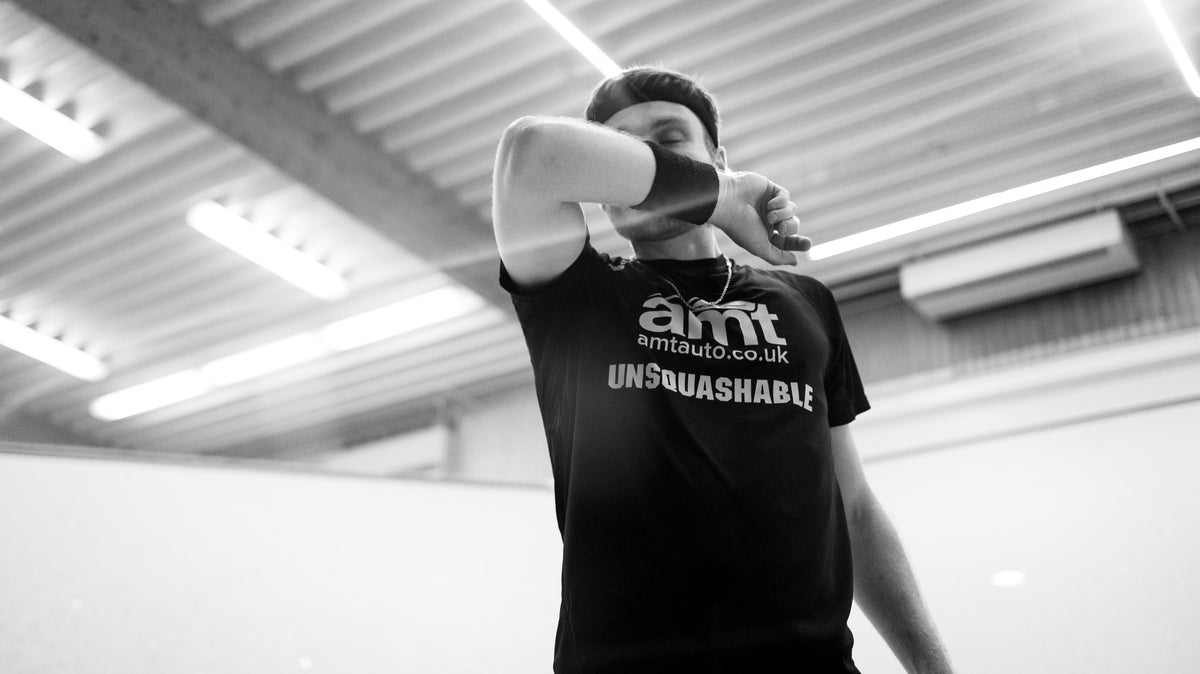
Jakub Pytlowany feels "a sense of mission" as he spearheads Poland's emergence as a credible force in international squash.
Pytlowany, who's based at Marc Lopez's Legia Warsaw Academy, won his first Poland National Championship title in June and is one of just a handful of male Polish players to go professional.
Players like Pytlowany and nine-time women's national champion Karina Tyma are the products of a strong Polish squash system that is bucking the trend of declining squash participation in many European nations.
Poland has a host of large big-city clubs like Hasta La Vista in Wroclaw (the world's biggest squash club with 32 courts), the 10-court Atras Squash Club in Krakow which opened in 2023, and a 17-court club in Katowice set to open at the end of 2027.
This infrastructure is populated by many vibrant junior academies and government funding for schools programmes such as Squash Junior Start, which saw 2,300 children register for open days this summer across 21 clubs after a successful launch in 2025.
This grassroots work is bearing fruit, with Poland's U15s reaching the final of the European U15 Mixed Team Championships for the last two successive years. Poland's men's and women's teams both played in Division 1 of the European Team Championship this year (the men for the first time).

As a 24-year-old pro who trains alongside many of Poland's top juniors at the Legia Warsaw Academy, Pytlowany is acutely aware of his role model status for Poland's new breed of young players.
"It really motivates me," he tells Squash Player. "I feel a sense of mission. I really want to show the younger players that it can be done, the way to be able to live your dream. I believe that it's possible, and so should they.
"I try to show other players that you don't have to be satisfied with playing a few Satellites. This doesn't have to be the case.
"If you do it properly, promote yourself and are professional on and off court, it is possible. I want my journey to be an example for others to follow. I want to show we can challenge the top guys — or at least give it a really good try."

Part of that self-improvement process for Pytlowany is to train with high-calibre players and receive expertise of a variety of coaches.
That's why he has spent several long spells training with the renowned Malik family in Sussex, England (which has clearly had a positive impact on his impeccable English as well as his squash), plus three trips to the Barcelona Global Squash Academy to work with head coach Victor Monserrat.
"I need to train with people who are much further up the top," says the world no.274. "Being exposed to that pace at which the game is played at the highest level is very important.
"Another very important factor for me is conversations with the players and coaches from abroad, that fresh eye. Someone watching you might see something or show you something you've not seen before."
Heading into the 2026/27 season, the Krakow-born player has several key targets in mind. Firstly, he wants to exceed his previous highest world ranking of 249 and break into the top 220.
"Setting yourself goals and then achieving them is a great example to others," he says.

Further ahead at the end of the season, two large milestones loom: the Polish Nationals where he wants to defend his title and bank another 100 PSA rankings points, but firstly, the qualifying tournament for the 2027 European Games next May.
The qualification tournament will feature players from nations who are not already represented among the 21 places in the European Games draw. As the top-ranked Polish player, Pytlowany would expect to be nominated by Polski Squash and would be in with a very credible chance of reaching the final, which would seal his place in Istanbul.
Pytlowany, who has two years left of a Law degree, receives financial support from the Polish federation as well as multiple sponsorships (including VMax Movie whose founder Mark Bellinger introduced him to the Maliks).
"I'm able to make it sustainable to travel the world and play the game, but there are also good people around the Polish squash community who want to elevate the game," he says.
"Like everywhere, we are seeing competition from padel and pickleball, but the response from most clubs and the Polish association isn't just, 'OK, let's switch to padel and give in to that growing wave.' We're using that challenge as an opportunity to progress the sport. I'm very happy about it.
"Squash in Poland is where England was 30 or 40 years ago, when it was a young sport. The first Polish Nationals were in 2002!
"Now it's a crucial moment. Are we going to go the same route as the rest of the European countries, or are we going to do something better? A lot of people see that challenge and want to make the future brighter."