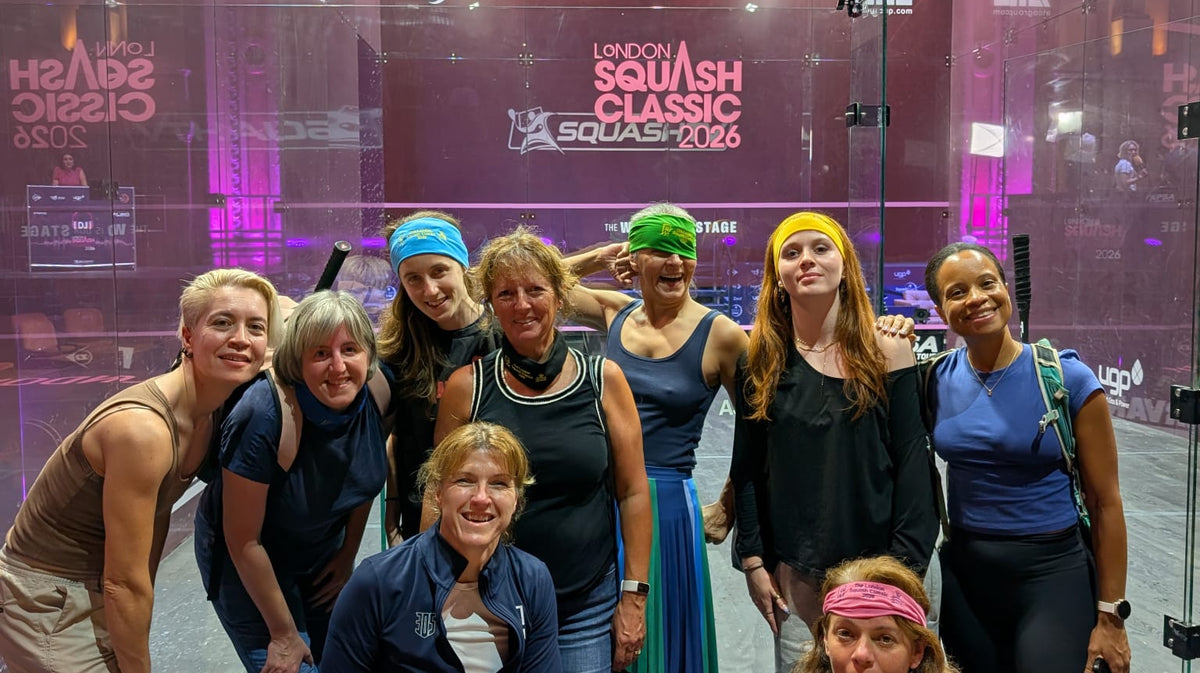
On the morning of Thursday, September 3rd 2026, 29 women and girls walked into the Coolhurst Tennis & Squash Club in north London for a day of squash.
None had been asked to bring a team, a ranking or a club badge.
Some had played for years, others had hit a ball against a wall only a handful of times, and by Sally Archibald’s count, 27 had given up a working day to be there.
The Women's Squash Festival, co-organised by Girls in Motion, the Middlesex Squash Association, London Squash and the Squash United Foundation, was built around a deceptively simple question: what happens when you keep the competition but remove the intimidation?
Beneath it sat a larger one that sport has been slow to ask of women. What do they actually want from it?
For Archibald, founder of Girls in Motion, the answer started with a sentence she had heard too many times.
"I get told a lot that women don't like competition," she tells Squash Player.
She never believed it. What she saw was a sport that had handed women a version of competition built for someone else, then read their absence as disinterest. So she changed the name. Her events would be festivals, not tournaments. The matches stayed just as competitive, but more women were willing to walk through the door.

It was that language, Stephanie Campos of the Middlesex Squash Association says, that drew her to Archibald's first festival at the Manchester Open. There she was offered something more: a turn on the glass court, the stage she had only ever watched professionals occupy.
“It doesn't matter what level of squash I am, I can still go and play," she recalls thinking. “It symbolised that squash is accessible to everybody.”
She carried the feeling south, and on September 3rd it took shape at Coolhurst. The day was designed, detail by detail, around a complaint Archibald hears again and again from league players.
In the traditional format, a woman faces one opponent in one match, and that match is the whole evening.
“If it's a rubbish match, that's it. You've had a rubbish night," she says. “If they don't get a good match, it's a wasted night. It's not something they want to go to."
At Coolhurst, nobody needed to arrive with a team. Players entered alone and were sorted into threes on the day, and across the afternoon ten teams worked through 56 matches, each logged on SquashLevels so that a relaxed afternoon still carried weight. The room stretched from a rating of 50 to 574, and every player still met opponents she could realistically beat.

Team Grey, made up of players Vita, Kasia and Anisha, took the title. Archibald had seen what a team does for a nervous player long before Coolhurst.
"The feedback I got was that it was great playing with lots of people at the same level as them. They were getting good matches," Archibald says.
"Putting them in a team took the pressure off that individual."
Her summer league in the North West follows the same logic.
"Everyone's coming away with confidence that they can win, because they've experienced a win," she explains.
"Even if you experience four losses in the night, the fifth one's a win. Suddenly everyone's experienced a win on the night, and they get a chance to play lots of different people."
That mattered to the women who came. Many play in clubs where they are one of only a few, and Campos says the festival changed that for some of them.
"A few of them said they'd connected and they're going to play outside, because it was local," she says.
"A lot of people were from north London, so they're not going to have to travel too far to meet up and arrange a game with each other."
Beneath the format lies an argument about who the sport was built for. Competitive squash has long treated a SquashLevel of 1,000 as the point at which a player properly joins the mix, a threshold Archibald believes was designed around men. Her ongoing research is leading her somewhere else.

“If you start as a beginner woman, you're unlikely to hit a thousand. You're probably more like three or four hundred, and that's actually the average squash level of the women's league players," she says.
"The standard ability is a lot lower than the perceived ability of the squash world."
Women, in other words, were never falling short. The measure was.
Her December 2025 survey of over 180 league players makes the same case from the other side.
Asked what they enjoy most about league squash, 70% of women said the social connection. Competition came fourth, at 48%, behind even fitness. And when asked what stands in the way of playing, the most common answer, at 34%, was not cost, confidence or childcare. It was having nobody at their level to play.
Archibald reads that as a description of what women's competitiveness really looks like, not a lack of it.
"They'd like to win, but that's not the point. The point is having that close match, and that's the competitive side of them."
The same thinking reached down to the ball. The double yellow dot, the default in most English clubs, is banned from every Girls in Motion event, and Archibald speaks about it with the conviction of a campaigner.
“It's completely inappropriate for most of the women's game, apart from maybe the top two percent," she says.
“I’m still going to beginner women's sessions and seeing the coach, usually male, pull out a double yellow and hand it to the women. They won't be able to get it going, and they certainly can't hit it to the back wall, so they're missing half the game.”
Her survey respondents had reached the same conclusion unprompted. Four asked for a single yellow dot, one writing that it “would make the rallies longer."
At Coolhurst everyone played with one, in short games to PAR 15 or 20, and the sceptics came round.
"At the very start we'll get pushback,"Archibald says, "but by the end of it they're loving it, because they can actually hit to the back of the court."
Stephanie Campos watched the change follow the players home. Days after the festival, one participant texted the group to ask whether they should be playing with a double or single dot.
“Ideally you play with a single dot," Campos told her, "because there's this ethos that we culturally just play with the double dot. Until that ball gets hit a few times and it's warm, it doesn't bounce. A lot of the issue is that women pick up squash and play with the wrong ball, and it's not very enjoyable."
The festival also offered women corners of the sport they had never been shown. Several tried marking and court management for the first time.

"Some people have never marked before, so suddenly they're getting a chance to do it in a nice, supportive environment with other women who will have the patience to teach them," Archibald explains, "rather than a league match with two men staring angrily at you while you're trying to make a call."
Even the professionals recognise the gap. When Tesni Murphy came to one of Girls in Motion's junior meets, Archibald recalls, she volunteered to return for the next. There had been nothing like it when she was coming up, only the boys to play with. Coaching is where Archibald is most pointed.
"A lot of clubs are still on about getting their ex-pro in," she says. "But do beginner women want that? Have you asked them? They're not going to get over a thousand squash levels, they're not going to play professionally. So how can you just work with that and make their game enjoyable?"
At Coolhurst, the morning belonged to coaches Lauren Selby and Emily Ison of Off The Wall Squash, and for many of the women it was the part that landed hardest.
"My most favourite thing was the coaching," one participant states. “I play squash regularly but have never had formal coaching and really appreciated the opportunity to learn about squash in this way."
Another said: "The enthusiasm and enjoyment factor was just brilliant. The coaches exuded passion, fun and enthusiasm, it was contagious."
For Campos, there was a second lesson in watching it. Ison, she says, came away with a sharper view of how women are often coached, with too little push and too much sameness, and was glad to have seen it first-hand. For one player, the value was in the sheer range of it.
"To get coaching, food, a tournament and pro squash tickets for the cost was great," she said. “It was brilliant to be in the company of so many women who enjoy squash."
She had spent months encouraging a complete beginner friend to try the sport, and the day gave them both what they needed.
“It worked well for her... and me, which is impressive," she said. Another felt the cost of a working day was repaid in full, calling the day "well worth" taking off "to be part of this wonderful crowd."
The day ended at Alexandra Palace, where the group travelled to watch the London Squash Classic and joined a Q&A with England's Sarah-Jane Perry. After hours of learning that the game could be theirs, the women saw it played at its summit. The Thursday date was chosen to make that possible, and Campos admits it was a gamble.
A weekday suits the women who already love the professional game. "For some that are really into it, they'll definitely take the day off work,” she says. For everyone else, it is a harder sell.
“If they don't know anything about professional squash, they're not sure about it."
Campos is wary of accessibility becoming a ceiling.
"There has been a lot of focus and effort on the performance structure, and maybe not enough focus on the engagement," she says.
But engagement alone is not enough either. "You want these events to be open to everybody, so people think these events are open to them. They need to see the progression through. Otherwise we end up losing them."

With fewer than ten active female coaches across London, her answer is to widen who is allowed to teach.
"For beginner squash you don't necessarily have to be a squash player, especially not at a high level,” she says. "You just need to be able to show them, have an enthusiasm to get on a sport, and know the basic rules of how to play."
Whether a gentler kind of competition keeps women playing is a question only time can settle, and nobody at Coolhurst claims otherwise. Archibald, though, has a hunch where the evidence will lead.
Women will not travel far for a lopsided match, she says, but give them a close one and the distance stops mattering. “I think women will travel over an hour for that."
The participants have already made their own case. “It will be great to have this event as an annual event."