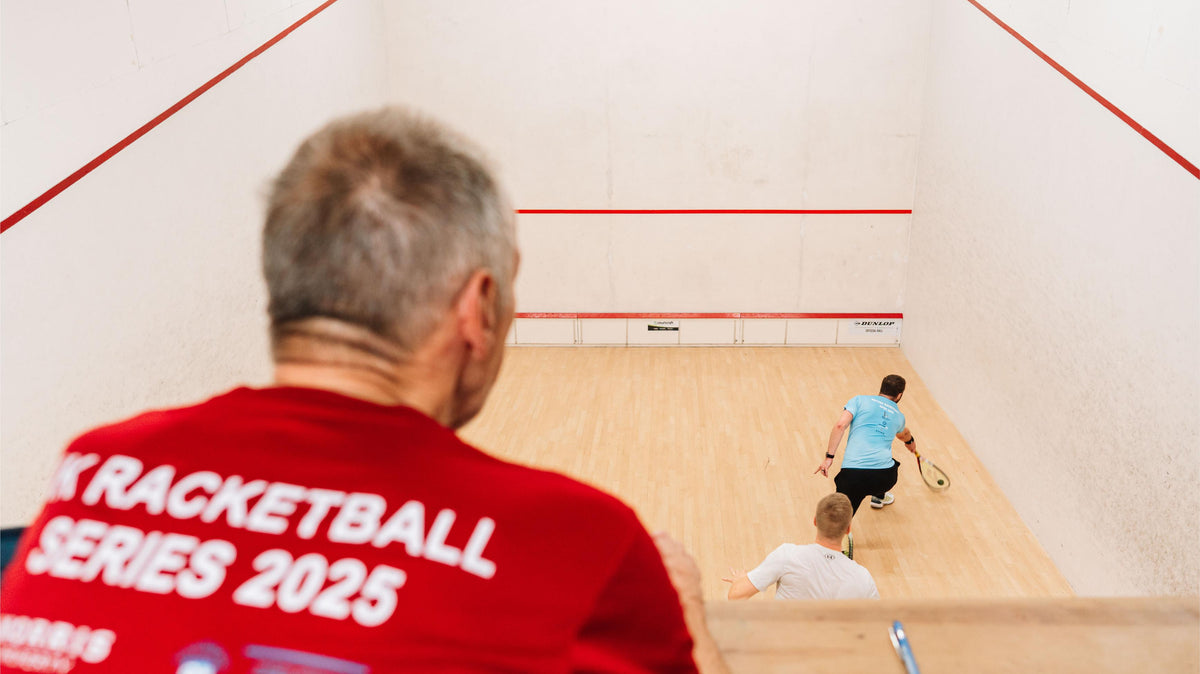
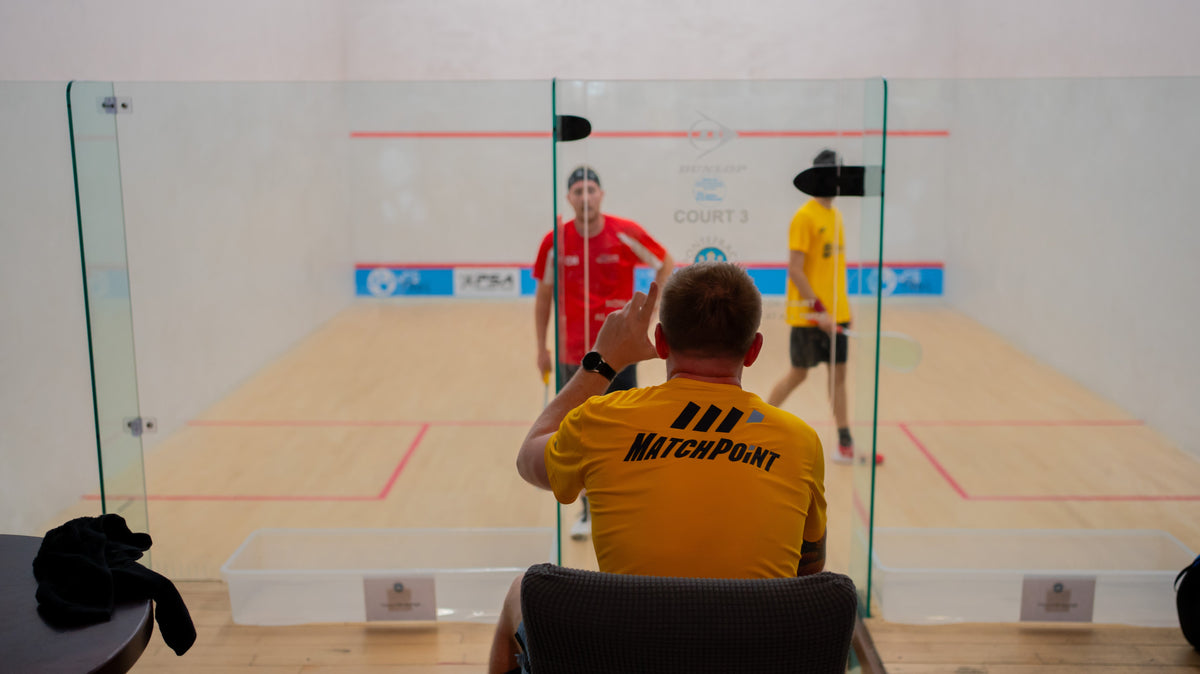
The trophy had barely been won before it was sitting in the middle of a Thai restaurant in Nottingham.
Around it were members of Team North, eating, drinking and replaying a day in which 96 amateur squash players had represented three regions of England across seven different grades. North had finished with 281 points, eight clear of South and 16 ahead of Central, and Cai Younger’s players intended to make the most of it.
“We had a good fun night out in Nottingham after,” Younger remembers. “We went out for a big Thai meal with everyone and had the trophy on the table and everything.”
It was a suitably informal conclusion to the first Tri-Regional Cup, an amateur competition that has taken one of squash’s most familiar formats and added something it does not usually have: teammates.
Thirty-two players represent each of the North, Midlands and South, divided into grades according to their SquashLevels rating. They play the same sort of opponents they might meet at any other graded event, but this time every finishing position contributes towards a regional score. Winning the A grade is worth 16 points. Winning the G grade is worth 16 points. A seventh-place play-off can matter just as much to the final standings as a match between the strongest players in the building.
The result is part graded tournament, part team competition and, increasingly, part weekend away.
There is, unmistakably, a little of the Ryder Cup about it.

“If you’re underperforming, you’re bringing the team down,” says Joe Magor, who runs CM Stringers Graded events across the South. “If you’re doing well, you’re bringing the team up. There’s an extra level of competitiveness because everyone has to pull their weight.”
For players accustomed to competing almost entirely for themselves, that changes the feel of a tournament.
Younger's MatchPoint circuit operates across the North of England and he has seen enough graded events to know what usually happens towards the end of a long day. Two hard matches have been played, legs are tiring and somebody discovers that their final assignment is a seventh-place play-off with relatively little at stake.
Motivation can disappear quickly.
“There’s something special about the Tri-Regional format,” Younger says. “Often when you get towards the end of the day and players have maybe had two tough matches, and they’re playing for a seventh-place play-off, they think, ‘Oh, I can’t be bothered.’
“But in this format you know you’re trying to get points for your team and everyone’s watching you. It gives you that added bit of motivation.”

That was the idea when Younger, Magor and current PSA professional Millie Tomlinson began discussing a team competition between their respective graded circuits.
Or, more accurately, when they began discussing two of them.
Younger had approached Magor about staging a North versus South event. Separately, Tomlinson, who runs tournaments on the MT Events tour across the midlands, had contacted Magor with almost exactly the same thought. By the time they realised what was happening, the obvious solution was not to choose between the two ideas but to combine them.
North versus South became North versus Midlands versus South.
The Tri-Regional Cup was born.
Magor had also been watching the Nations Cup staged alongside the World Masters, where individual performances accumulate points for each player’s country. He wondered whether the same principle could be dropped into a normal graded tournament without making the event complicated.
It could.
Players enter. SquashLevels determines the grades. Matches are played. Positions earn points. Add the totals together and somebody goes home with a trophy.
The simplicity is part of its appeal.

There is no attempt to turn club players into professional athletes for a weekend or manufacture some grand sporting spectacle. The competitiveness comes from attaching a little more consequence to matches players would happily have played anyway.
It also changes who they meet.
Most graded squash naturally becomes regional. Players repeatedly encounter people from neighbouring clubs and local circuits; rankings may move, draws may change, but familiar names return.
At the Tri-Regional Cup, somebody from Hertfordshire can suddenly find themselves opposite an opponent from Yorkshire whom they have never seen before.
“There are way more people you’ve never met before at one of these tournaments,” Magor says.
“The guys from my area wouldn’t have played as many North and Central events. So you basically turn up and play four completely different people you’ve never played before.”
Tomlinson noticed the difference from inside the competition after being persuaded to play in the second edition, having watched the first from the organiser’s side.
“This one feels a lot more social,” she says. “It’s quite nice that everyone’s supporting each other, and it encourages people to meet and talk a bit more.
“That’s something we want to try and do with the graded tournaments: help people make connections and create that sense of community. You’ll find other people on Team Central and get to know them a bit - in the preamble to the tournament, we even set up a huge whatsapp group to help get people in the team spirit ahead of the event.”

That has happened almost as much off court as on it.
Around 35 players stayed overnight after the inaugural event in Nottingham. Team North went for their celebratory Thai meal. Players who would ordinarily have driven home after collecting their final result instead remained together into the evening.
It is a small detail, but an important one for three tournament organisers whose regular events are built around precisely this level of player.
Younger, Tomlinson and Magor each operate their own circuits and, on paper, might be expected to regard one another as competitors. In practice, they talk regularly, exchange advice and help solve the mundane problems involved in organising amateur squash: draws, venues, entries, timings and the hundred other things that can go wrong between opening registration and putting the final players on court.
Tomlinson and Magor already stage a joint Christmas tournament in Lincoln. The Tri-Regional Cup simply takes that working relationship further.
Crucially, the rivalry remains.
After North edged the inaugural competition in Nottingham, the Cup moved to Pontefract for its second edition this summer. The organisers also tightened the scoring system, switching from aggregate points to an average after the three regions arrived with slightly different-sized squads.
North won again.
The trophy will head south next, with Hertfordshire the likely venue, giving Team South home advantage and North the opportunity to attempt a hat-trick.

By then the competition will have completed its first lap of the country: Midlands, North, South.
That travelling element has begun to give the Cup a character of its own. Players have a region to represent. The hosts change. There is a defending champion to beat.
People travel further than they would for a normal graded event. Opponents become teammates for the day. Players start looking towards matches elsewhere in the draw because somebody else’s result might determine whether their region wins.
None of this changes the basic proposition.
It is still 96 people turning up to play amateur squash.
That may be precisely why it works.
The Tri-Regional Cup has not reinvented graded competition. It has simply taken something that thousands of recreational players already understand and given them another reason to care.
Win your match. Win your grade. Win it for the North, Midlands or South.
And if it all goes particularly well, put the trophy in the middle of the restaurant table afterwards.