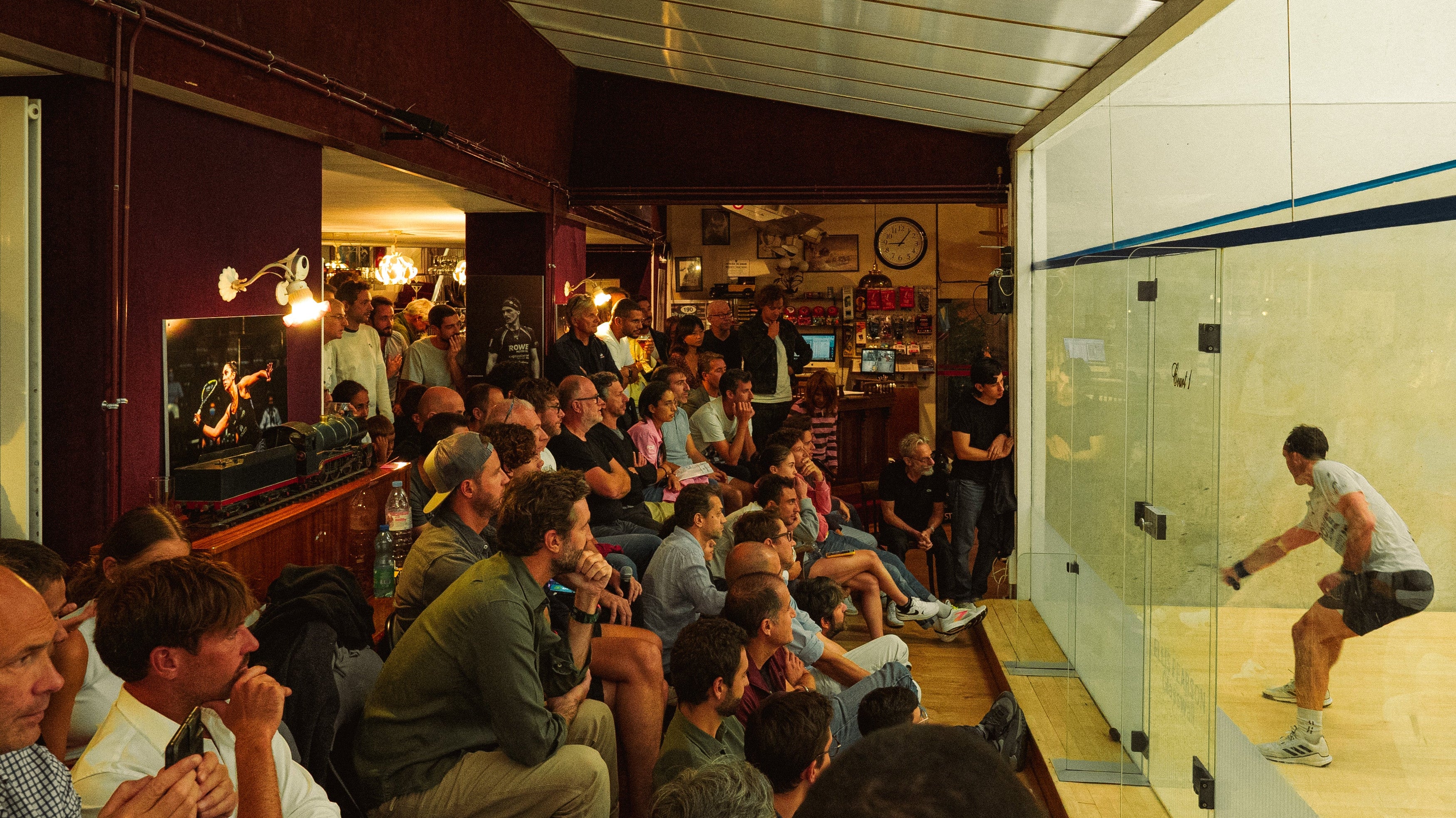




While it may look small on the TV screens, the squash court is a deceptively large playing area – and a good player can make the limited size of the court feel even bigger for their opponent through the use of angles.
The dimensions of the squash court are regulated by the World Squash Federation, with the standard court measuring as follows:
- Length of 32 feet (9.75 meters)
- Width of 21 feet (6.4 meters)
- Total area of 672 square feet (62.4 square meters)
The wall at the back is called the back wall while the one on the front is called the front wall. The two walls on either side are side walls.
- The back wall line has a height of 7 feet (213.4 centimeters)
- The front wall of a singles squash court must meet a minimal clear height of 18.5 feet (5.64 meters)
- The service line is at 5.84 feet (1.78 meters),
- The tin line at 17 or 19 inches (48 centimeters) depending on the competition.
Behind the short line and adjoining the two side walls, two service boxes (1.6mx1.6m) are drawn.
A half-court line, parallel and equidistant to both the side walls is then drawn from the short line to the back wall. The half-court line and the short line essentially forms a T with the back wall as base.